Template note. Change the WordPress post title, then update the H1 below to match it. Replace the top image if you need one. Fill any optional blocks you want to use. Blocks that still contain placeholder markers will stay hidden on the frontend. Also set a WordPress Featured Image if you want blog cards and previews to show a thumbnail.
On this page
Most packaging teams do not begin by asking for booklet labels. They get there after a standard label has already started to struggle.
The pattern is usually the same. Marketing wants the front panel to stay clean. Regulatory needs more text. Sales wants to use one package in more than one market. The bottle has not changed, but the copy keeps growing. Somebody reduces the type size. Somebody else asks whether part of the instructions can be moved somewhere less visible. At that stage, the problem is no longer just artwork.
A standard roll label is still the right answer for plenty of products. If the content is short, the package has enough panel space, and the label only has to do one simple job, there is no need to force a more complex construction into the project.
But when the copy keeps expanding and the panel does not, buyers usually reach the point where they have to make a more honest decision: keep pushing a standard label past its limit, or switch to a format that was built for heavy content in the first place.
What Booklet Labels Actually Are
Booklet labels are extended content labels built with an added printed leaflet, folded booklet, or multi-panel insert attached to a pressure-sensitive label base.
In simple terms, they give the package more room for text without forcing the brand to move to a larger bottle, wider jar, or secondary carton just to carry instructions and compliance copy.
What buyers sometimes underestimate is that a booklet label is not only a space solution. It changes the construction of the label itself. The face material, the way the booklet opens, the reseal behavior, the finished thickness, and the way the label moves through an applicator all have to be considered earlier than they would on a normal roll label job. If the format uses folding or multiple panels, our folded label troubleshooting guide reviews fold lines, page order, adhesive zones and artwork errors.
On real projects, this is usually where the factory starts asking better questions than the artwork file can answer. We need to know the container type, the usable label panel, whether the label is applied by hand or machine, whether the outer layer needs gloss or matte lamination, and whether the booklet has to stay easy to open but still close securely after use. Without that information, a booklet label quote is often only a rough starting number.
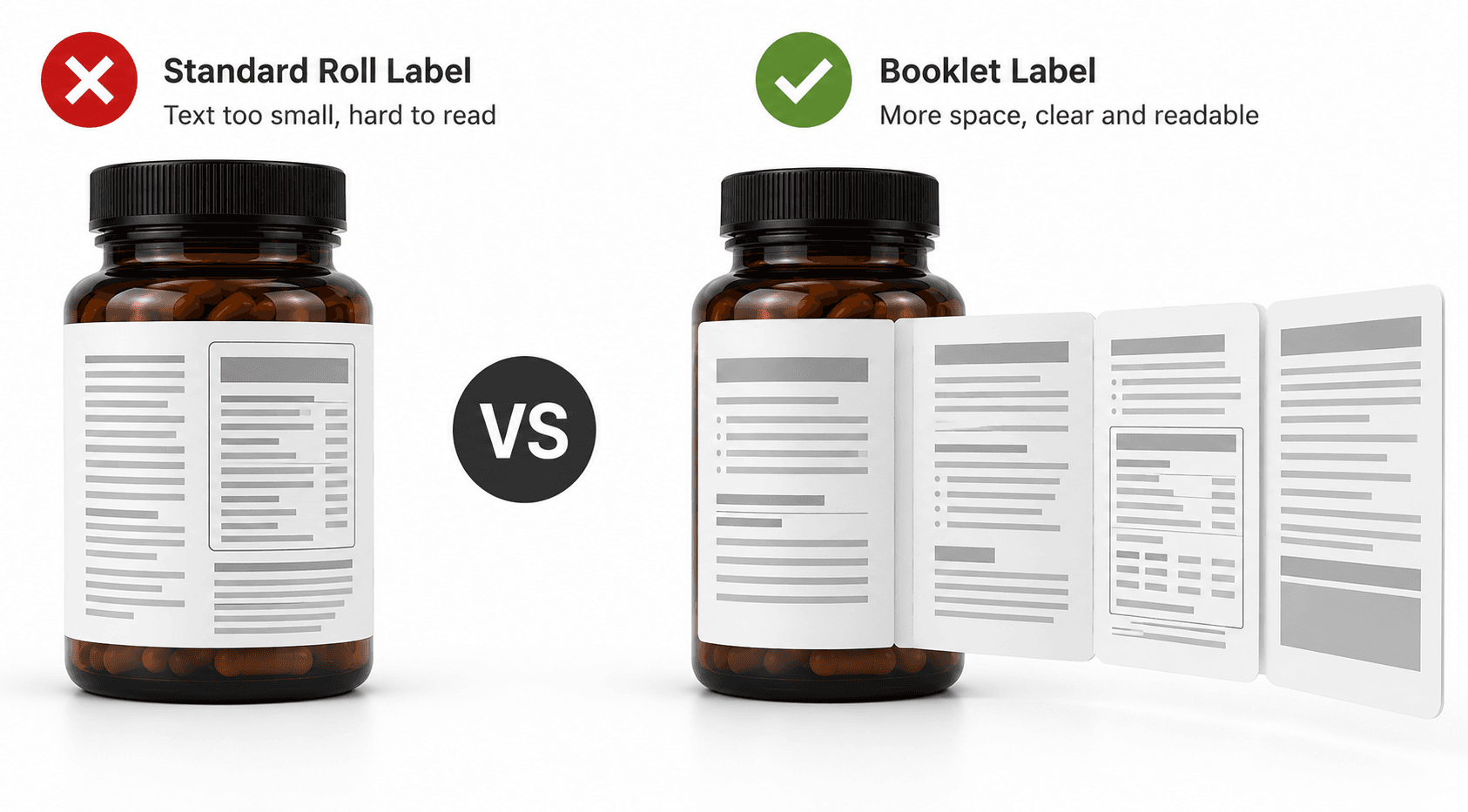
The First Sign a Standard Roll Label Is No Longer Enough
The first sign is not always obvious.
A supplement brand may be trying to fit product claims, directions, storage statements, ingredient details, distributor information, and batch content onto one small bottle.
In another project, the issue is not supplements at all. It is a cosmetic SKU that now has to serve two or three markets, so one quiet artwork file suddenly turns into a multilingual packaging problem.
For industrial and chemical products, the trigger is often even more blunt: the warnings and handling notes take up more room than the brand story.
And sometimes there is no dramatic regulatory discussion at all. The design simply looks fine on screen, but when you print it at actual size, the text is too small to use.
That last one matters more than people admit.
A lot of packaging teams keep pushing standard labels further than they should because changing the format feels more disruptive than changing the artwork. In practice, once the label is overloaded, the file keeps changing but the problem does not.
Where Booklet Labels Usually Make the Most Sense
Booklet labels are not for everything. Still, there are a few situations where experienced buyers usually stop trying to rescue a standard label and move on.
1. Multilingual packaging
If one package needs to serve multiple countries, text volume climbs fast. Product details, usage instructions, warnings, storage advice, and other mandatory copy do not stay small for long.
This is one of the cleanest use cases for booklet labels because the space problem is structural, not cosmetic. You are dealing with a packaging format that has to hold more information than a normal face label was designed for.
For projects that cross markets, teams often also end up checking barcode, language, and packaging data requirements against GS1 standards.
2. Supplements and health-related products
This is where buyers get trapped all the time.
The bottle is small. The brand still wants it to look premium. The content is heavy. Nobody wants to sacrifice the front panel. So the label keeps getting revised until the type is technically there but practically useless.
We see this most often on small bottles and sachet-style health products. On screen the file still looks acceptable. At print size, it is another story. We have seen customer files where critical text was pushed so small that once the job reached prepress, changing to a booklet construction was already the only sensible option. This is exactly why many supplement label projects should evaluate booklet construction earlier instead of waiting until the copy no longer fits.
Booklet labels can make sense here when the content load is genuinely heavy and there is a real need to keep both presentation and readability under control. This is also where application conditions matter. A small supplement bottle on an automatic line behaves differently from a large jar labeled by hand, and booklet construction that works on one may be the wrong choice for the other.
3. Chemicals, laboratory products, and industrial packaging
Safety information is not decorative copy. It has to be there, and it has to be usable.
When there is no realistic way to carry all required information on a single-layer label without crushing readability, extended content formats become much easier to justify. For these projects, durability matters too. If the package may face abrasion, oil, or frequent handling, the outer panel and lamination need to be chosen with more care than on a simple decorative label.
On industrial and chemical projects, some of that content is driven by hazard communication requirements, so there is usually less room to negotiate what stays on-pack.
4. Small containers with limited panel space
This one sounds basic, but it is where many label format discussions should begin.
If the package is physically small, no amount of optimism changes the printable area. Buyers sometimes treat this as an artwork problem when it is really a geometry problem. And if the bottle is round, tapered, squeezable, or running on an older rotary labeler, the label construction gets even less forgiving.
This is why factories ask for a bottle sample, a dieline, or at least a container photo with dimensions before confirming booklet label structure. Without that, too many decisions are still guesses.
When Standard Roll Labels Are Still the Better Choice
It is easy to oversell booklet labels if you only look at space.
That would be a mistake.
A standard roll label is still usually better when:
- The copy is short and not likely to keep changing.
- The package has decent panel space.
- The label only needs one language.
- The line is fast and the team wants the simplest possible application setup.
- Cost control is the bigger issue, not content capacity.
- There is no real need for peel-and-reseal behavior or layered instructions.
Some teams jump to booklet labels too early because they assume a more complex format automatically looks more premium. That is the wrong reason to choose it. If the content still fits comfortably on a standard roll label, keep the job simple. Standard roll labels are cheaper, easier to run, and usually easier to approve.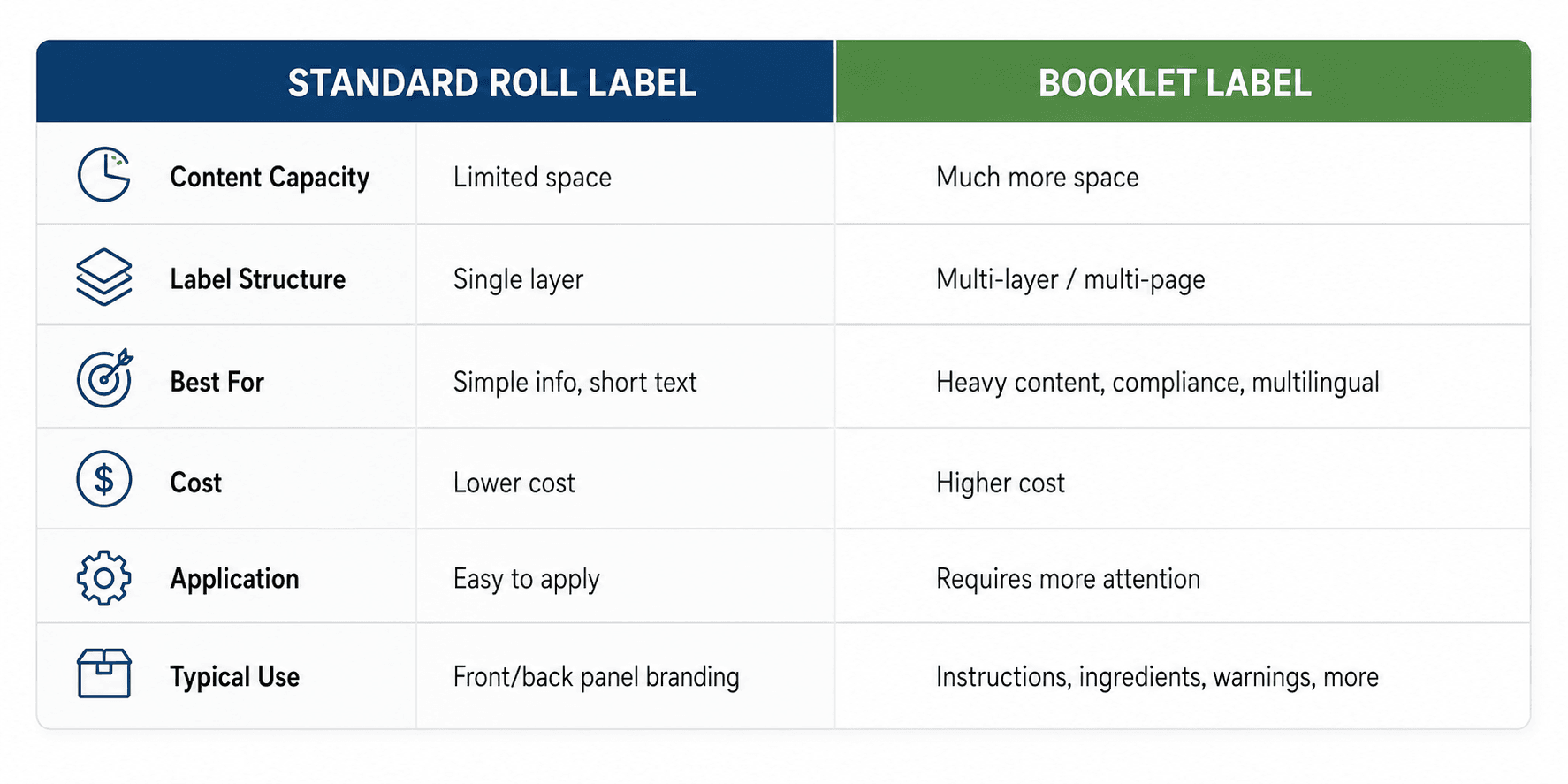
Booklet Labels vs Standard Roll Labels
This is the part procurement teams should focus on: booklet labels are not automatically better. They are just better suited to one specific kind of headache. If the real issue is limited content space, they can be the right tool. If the real issue is that the copy has not been edited yet, they are too much construction for a problem that still belongs in the content file.
What Changes in Production Once You Move to Booklet Labels
This is where the conversation starts sounding less like marketing and more like packaging engineering.
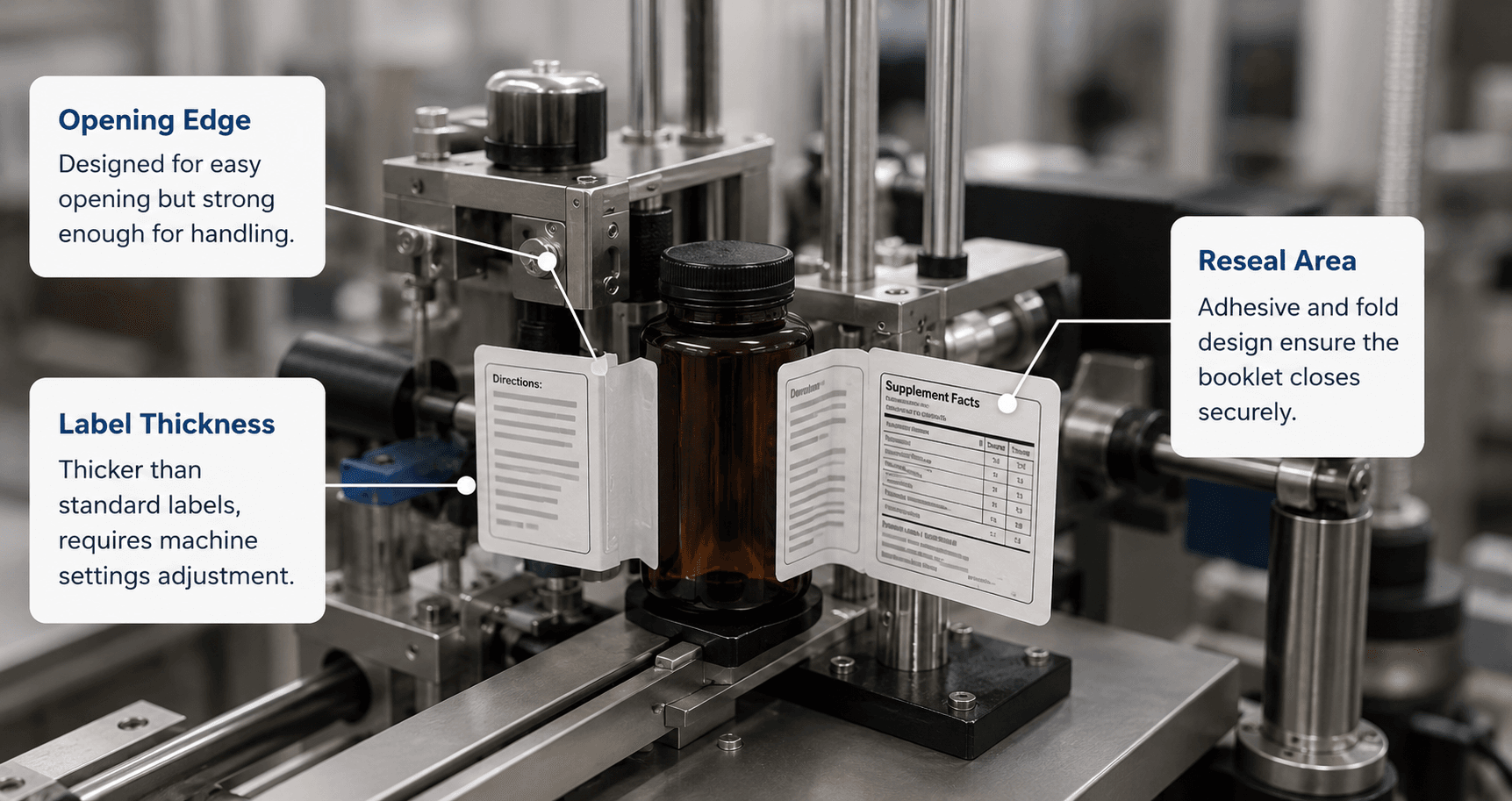
Once a project moves from a standard roll label to a booklet label, the factory usually starts checking things that did not matter much before. Label thickness increases. Opening edge and reseal performance become part of the job. Machine speed may need a closer look. A bottle that works well with a simple wrap label may become more sensitive once the label construction is heavier and more layered.
That does not mean booklet labels are difficult by default. It means they need to be matched to the real application method.
For example, if the label is being applied on a round bottle at speed, the supplier may need to review how the booklet edge sits on the container, whether the opening side is likely to lift, and whether the reseal adhesive needs adjustment. If the package will sit in a bathroom, kitchen, or warehouse environment, moisture resistance, oil resistance, and outer-panel lamination become part of the decision as well.
These are the kinds of details that make a quote more accurate and a production run less eventful.
Questions Buyers Should Settle Before Requesting a Quote
Before asking for pricing on booklet labels, settle the fundamentals first.
Not every detail needs to be final. But a few things do need answers:
- What content absolutely has to stay on-pack?
- How many languages are involved?
- What is the finished label size available on the container?
- Does the label need peel-and-reseal performance?
- Is the package round, flat, tapered, flexible, or squeezable?
- Will the label be applied by hand or machine?
- How fast is the application line?
- What environment will the label face: oil, moisture, friction, cold storage, or regular shelf conditions?
- Does the brand need a premium visual finish on the outer panel?
In real projects, we usually ask for the container photo, label size, application method, and content file before quoting. If there is already a dieline or bottle sample, even better. Without those details, the first price is often only a rough estimate because booklet label construction depends heavily on the container and on how the label will be applied.
Buyers who skip this stage often end up in the same loop: they ask for price first, then discover the construction choices, then realize the container or content structure should have been discussed earlier.
Common Mistakes Buyers Make With Booklet Labels
The first mistake is waiting too long.
By the time booklet labels are discussed, some teams have already approved artwork for a standard label that was never realistic. That creates rework and makes the booklet option look expensive, even though the real cost came from spending time on the wrong format first.
Other common mistakes include:
- Treating booklet labels as a last-minute print upgrade instead of a structural packaging decision
- Failing to confirm how much content really needs to stay on-pack
- Ignoring container shape and label application method
- Choosing the format before discussing opening and reseal behavior
- Assuming all extended content labels behave the same way
- Waiting until final artwork to involve the printer
- Sending only a front-panel design file without the full content file
- Expecting an accurate production quote without a dieline, bottle sample, or application details
One very common version of this looks like this: the customer sends a beautiful front label PDF, but the instructions, warnings, and multilingual copy are still sitting in a separate Word file. At that point nobody is really quoting the finished label yet. They are quoting an assumption.
One more mistake shows up a lot in multilingual projects: people assume translating the copy is the hard part. Usually it is not. Usually the harder part is finding a construction that still works once all that translated copy has to live on one bottle without becoming unreadable.
What a Supplier Should Ask Before Quoting Booklet Labels
A serious booklet label supplier should ask more than quantity and dimensions.
- Container type and label panel size
- Whether application is manual or automatic
- Approximate application speed if the labels will run on a line
- How much content needs to be carried
- Whether multiple languages are involved
- Whether peel-and-reseal performance matters
- Whether the outer panel still needs a strong retail look
- What durability conditions the label will face
- Whether there are existing samples, dielines, or regulatory layouts to review
- Whether a test run or pre-production sample is needed before mass production
If the supplier is not asking these questions, pause there. It does not automatically mean they are the wrong vendor, but it usually means the conversation is still too shallow for a format that depends so much on container shape, opening behavior, and application method.
To put it more plainly: if a vendor is willing to quote booklet labels from one flat artwork PDF and nothing else, that quote is probably too optimistic to trust.
The Real Decision Is Not About Space Alone
Buyers do not choose booklet labels because the format sounds more advanced. They choose them when the package has outgrown what a standard roll label can carry without creating readability or compliance problems.
Yes, the unit price is usually higher than a normal roll label. But if the alternative is switching to a larger bottle, adding a carton, or sending the artwork through three more revision cycles because the content still does not fit, that higher unit price is often the cheaper decision in the real world.
Once that point arrives, the better move is to evaluate the correct construction early, while there is still time to review the content, the container, and the application method properly.
If you are comparing booklet labels, extended content labels, or standard roll labels for a supplement, cosmetic, chemical, or multilingual packaging project, you can request a custom label quote here and send your label size, container type, content file, and application method for review.
Quick Answer
Booklet labels make sense when a standard roll label cannot carry the required content without creating readability, compliance, or application problems.
They are especially useful when you need:
- Multilingual packaging content
- Supplement facts, usage instructions, warnings, or ingredient details
- Chemical or industrial safety information
- Small containers with very limited label space
- Promotions, instructions, or expanded product education on-pack
- Peel-and-reseal performance instead of a one-layer label
If the copy is already being reduced, hidden, rearranged, or forced into unreadable type, it is usually time to question the format instead of revising the artwork again.
Comparison Table
| Factor | Booklet Labels | Standard Roll Labels |
|---|---|---|
| Content capacity | High | Limited |
| Best use case | Dense, multilingual, instructional, or compliance-heavy packaging | Simple product information and branding |
| Application complexity | Higher | Lower |
| Unit cost | Higher | Lower |
| Design freedom on front panel | Better, because content can move inside | More limited if content load is heavy |
| Best for small containers | Often yes, when content still has to fit | Often difficult when copy is heavy |
| Reclose / peel function | Possible | Usually not part of the construction |
FAQ
Booklet labels are pressure-sensitive labels with an attached printed booklet or folded leaflet that adds extra content space on-pack. In production terms, you are no longer dealing with a simple face stock and adhesive only. You are dealing with a thicker, layered construction that has to open properly, close properly, and still run on the actual package.
When should I use booklet labels instead of standard roll labels?
Use booklet labels when a standard roll label cannot hold the required copy without causing readability, compliance, or design problems. In real projects, that usually shows up when the type is getting too small, the package needs more than one language, or the team is already hiding important information just to keep the front panel clean.
Are booklet labels the same as extended content labels?
Booklet labels are one type of extended content label. The broader category can also include other multi-layer or peel-and-reveal constructions depending on the application. The right choice depends on how much content you need to carry, how often the label will be opened, and whether the package is being labeled by hand or on a machine.
Are booklet labels good for supplements?
They can be. They are especially useful when a supplement package has limited label space but still needs to carry dense product information, directions, warnings, or multilingual content. Small bottles are where this comes up most often, especially when the brand wants a clean look but the regulatory and usage copy keeps growing.
Do booklet labels cost more than standard roll labels?
Yes. Booklet labels usually cost more because they involve extra layers, folding, finishing, and more careful application testing. However, for content-heavy packaging, they may reduce redesign time and avoid bigger downstream changes, such as moving to a larger bottle, adding an outer carton, or reworking the artwork after the package size has already been approved.
Need Help Deciding Between Booklet Labels and Standard Roll Labels?
If you are comparing booklet labels, extended content labels, or standard roll labels for a supplement, cosmetic, chemical, or multilingual packaging project, send One Print Pack your label size, container type, content file, and application method. If you already have a dieline, bottle sample, or machine details, include those too. We can review whether a standard roll label is still practical or whether a booklet label construction makes more sense for your packaging.