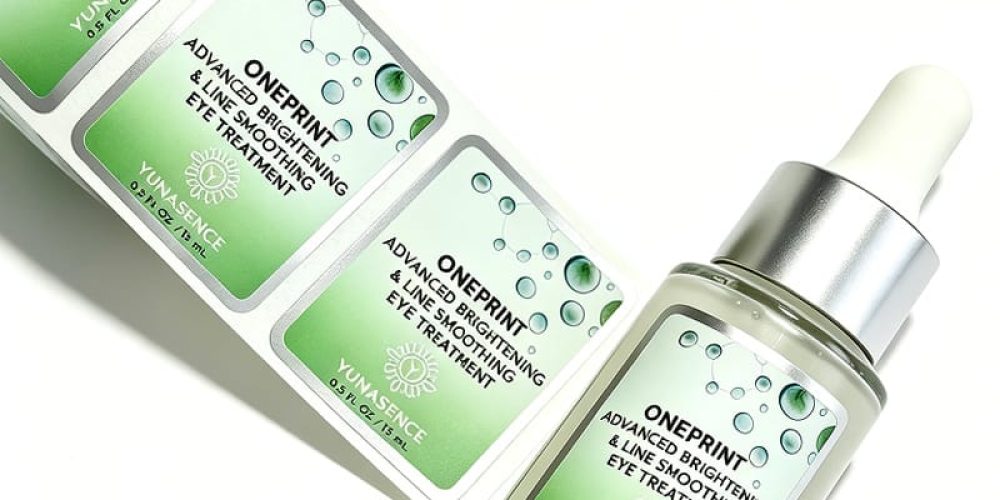
Many beauty brands ask for waterproof cosmetic labels before they fully understand what the package will face in real use.
The bottle is approved. The artwork is approved. Then somebody notices that the beautiful clear label chosen for a skincare oil bottle does not stay clean once real product starts touching the package.
At that point, nobody is talking about visual taste anymore. They are talking about delay, rework, and who signed off too early.
That sounds specific until you look at the actual package.
A shampoo bottle sits in steam and water. A serum bottle may stay mostly dry, but the neck gets oily and the label gets rubbed by fingers every day. A lotion bottle may flex each time the user squeezes it. A facial oil bottle may only need a small front label, but that label has to keep looking clean when oil residue builds up around the cap. If the brand wants a clear look on a curved bottle, even small edge lift becomes visible fast.
So the job is not really about one word.
It is about matching label material, adhesive, and finish to the way the package will be used after production.
That is also why buyers often get conflicting advice. One supplier is thinking about moisture. Another is thinking about visual appearance. A third is quoting from artwork and size only. By that point, nobody is looking at the whole packaging situation.
We have seen this play out too many times. A customer tests the label on a clean office sample, everything looks perfect, everyone signs off, and then the real bottles go into a damp bathroom environment. Three days later the clear label starts lifting on the curve, the edge goes milky, and the customer is asking why the sample looked fine but the production batch does not. Once the goods are already packed or shipped, that is not a small correction. It is a mess.
What Buyers Usually Mean by Waterproof Cosmetic Labels
When buyers ask for waterproof labels for cosmetic packaging, they are usually trying to avoid one of these outcomes:
- the label wrinkles or scuffs in a wet bathroom
- the print starts looking tired after repeated use
- the edges begin lifting on a curved bottle
- lotion or oil residue makes the label look dirty
- a clear label loses its clean no-label look
So waterproof often becomes a stand-in for durable, clean-looking, and problem-free.
That is where the brief usually gets too loose.
A label can tolerate moisture and still fail on an oily serum bottle. A clear label can look excellent on a clean rigid sample and then start showing haze or adhesive whitening once the bottle goes into real use. A white film label that performs well on a shampoo bottle may not be the best answer for a small facial oil bottle where appearance matters more and residue risk is different. On US-facing projects, teams also end up checking how crowded the panel becomes once they review packaging copy against FDA cosmetics guidance.
For that reason, cosmetic label material selection should be treated as a packaging decision, not only a print finish choice.
To be blunt, a lot of trouble starts because teams keep using the word waterproof as if it answers the whole job. It does not. It is only one piece of the brief.
When Oil-Resistant Labels Matter More Than Waterproof Labels
This comes up most often in skincare projects.
Shampoo and shower packaging usually put water at the center of the conversation. Serum bottles, lotion bottles, facial oils, hand creams, and treatment packaging often go in another direction. The label gets touched after use. The bottle collects residue around the pump or shoulder. A user wipes it with a finger, then puts it back on the shelf. That repeats for weeks.
On these jobs, the label may stay attached and still look bad.
That is already a failure if the product is supposed to look premium.
Oil resistant labels for skincare bottles matter because the damage is often visual before it becomes structural. The print surface starts looking dull. A clear edge stops looking invisible. Adhesive whitening shows up where the brand wanted a clean no-label look. Buyers sometimes think they need stronger glue when the bigger issue is that the selected material and surface protection were never right for the product.
This is one of those details that sounds small until the product is on shelf. Then it stops being small. A lotion bottle with a tired-looking label does not feel like a premium skincare item anymore, even if the label is technically still stuck on.
In practice, many waterproof cosmetic labels fail not because of water alone, but because the material does not match oils, handling, and bottle shape.
Recommended Label Materials for Cosmetic Packaging
Most buyers want a practical starting point before they send files for quotation.
That is fair.
No one wants a long theory discussion when they are trying to source labels for a bottle line or a new skincare launch.
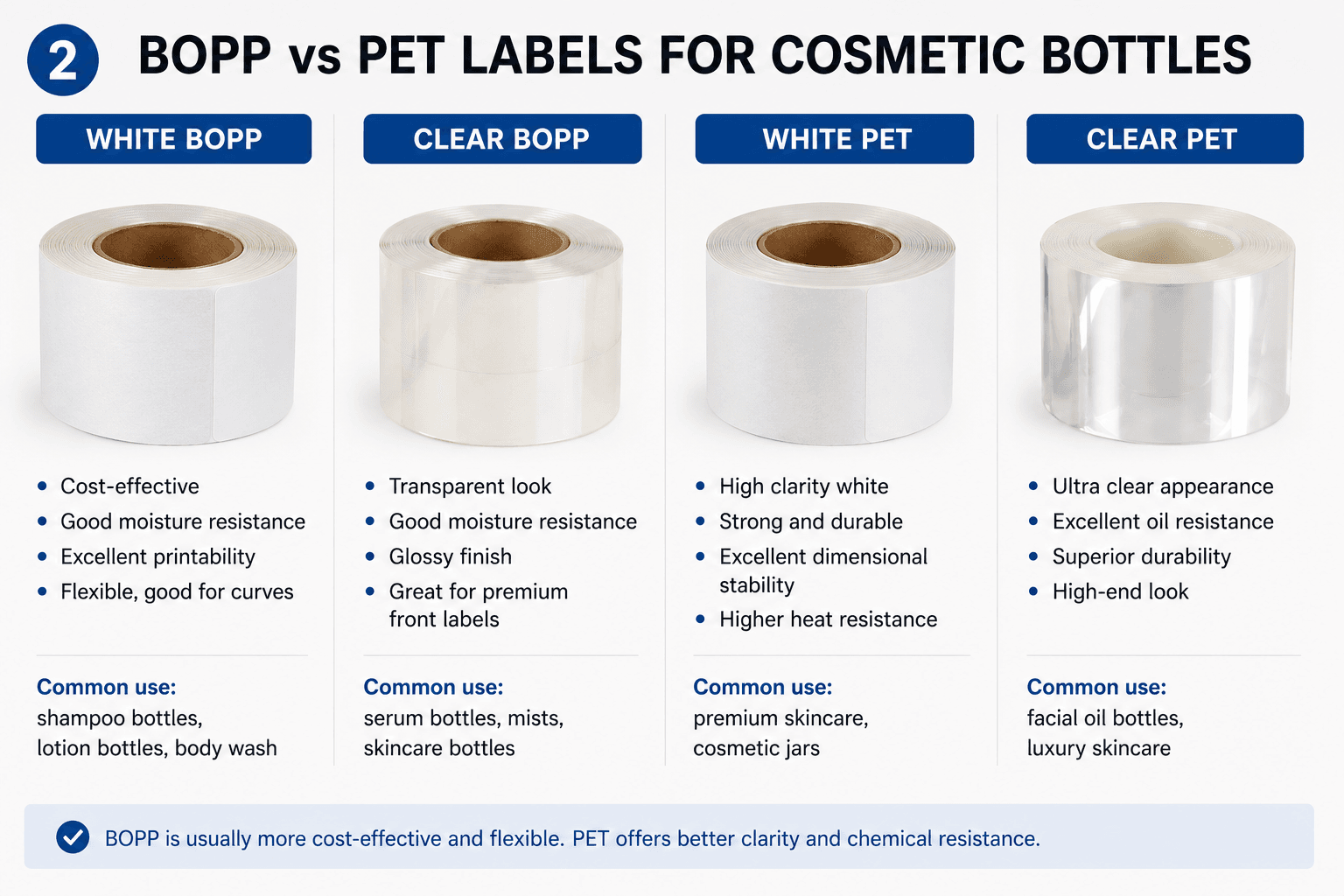
BOPP vs PET Labels for Cosmetic Bottles
For cosmetic bottle labels, BOPP vs PET is one of the most common comparisons.
BOPP labels for cosmetics are often the more practical option across mainstream personal care packaging. They balance cost, printability, flexibility, and moisture performance reasonably well. For labels for shampoo bottles, body wash, lotion, and many everyday skincare products, BOPP is usually where factory discussions begin.
PET labels for cosmetic bottles are more likely to make sense when the packaging needs a cleaner premium appearance, better stiffness, or stronger resistance in situations where the label construction has less room for error. Facial oil bottles, luxury cosmetic packaging, and some clear label projects often lean in this direction.
The useful comparison is not which one sounds better on paper.
It is:
- Is the bottle rigid or squeezable?
- Is the package heavily curved or mostly flat?
- Is the label clear or opaque?
- Will the bottle face oil, moisture, or both?
- Is visual cleanliness more important than lowest unit cost?
Do not choose based on how it sounds in a spec sheet. Choose based on how it actually behaves on the line.
If you want the short version, here it is. For mass-market shampoo, lotion, and body care, BOPP is often the safer and more economical choice. For smaller premium packaging where clarity, stiffness, or a cleaner transparent presentation matters more, PET earns its place. Buyers get into trouble when they jump straight to the premium-sounding option before checking whether the bottle and budget actually need it.
I say this to customers all the time. Do not spend PET money before the product has even proved it needs PET. For a lot of mainstream shampoo and lotion projects, white BOPP is the more sensible choice. It performs well, it quotes cleanly, and it leaves more of the budget for the bottle, cap, or outer presentation that the customer may actually notice first.
Best Waterproof Cosmetic Labels for Shampoo, Serum, and Lotion Bottles
Different formats create different failure points.
Labels for shampoo bottles usually need a practical film material that can live in bathroom humidity and regular water contact without becoming a complaint later. These jobs are often less about luxury appearance and more about steady performance at a sensible cost.
Labels for serum bottles are trickier. The bottle is often small. The brand wants it to look clean. The user handles the neck and cap more carefully, but the residue around the dropper or pump can be much worse. That is why clear cosmetic labels for bottles are attractive here, but also why they need more caution.
Labels for lotion bottles bring rubbing and squeezing into the picture. If the package flexes and the label panel curves, a structure that looked fine on a straight sample bottle may start showing weakness in real use.
This is also why experienced buyers send more than artwork. A dieline helps. A bottle photo helps. A bottle sample helps even more. Without those, the factory is still making too many assumptions.
One small detail people ignore all the time is the bottle shoulder. On a straight bottle, a label may apply cleanly and stay quiet. On a tapered lotion bottle or a small curved serum bottle, the top edge or side edge becomes much more sensitive. That is often where clear label edge lifting starts first.
For buyers comparing waterproof cosmetic labels, the better question is which material works on the actual bottle, not which label sounds better in a quote.
Clear Cosmetic Labels for Bottles: When They Work and When They Fail
Clear cosmetic labels for bottles can look excellent on skincare, mist, and premium cosmetic packaging.
They can also expose every weak assumption in the job faster than almost any other label style.
Once the label is meant to disappear visually, edge lift, adhesive whitening, haze, and small application flaws become hard to ignore. A minor flaw that would pass on an opaque label can make a clear label look cheap.
Clear labels work best when:
- the bottle surface is consistent
- the adhesive is matched to the container
- the expected environment has been discussed before quoting
- the team has tested the label on the actual package, not just a flat proof
They become riskier when:
- the bottle is oily
- the package is heavily curved
- the label sits in a humid bathroom
- the no-label look matters more than the team has allowed for in testing
One very common problem on curved bottles is clear label edge lifting. The center panel looks fine. The print looks fine. Then the edge near the curve starts to lift slightly, and because the label is clear, the failure is easier to see than it would be on white film.
The office sample still looks good.
The production bottle tells a different story.
We have also seen jobs where the label itself was not badly printed at all. The problem was that the customer wanted a neat no-label look on a small curved bottle, but did not want to slow the application line or review a bottle sample before mass production. Once the lifting starts, there is nothing elegant about it. Everyone just wishes the argument had happened earlier.
And to be honest, if the bottle surface already has obvious curvature, panel inconsistency, or texture, a transparent label may only magnify the problem. Some bottles simply do not forgive a clear construction, no matter how attractive the mockup looked in the sample room.
How Bathroom Moisture, Oils, and Handling Affect Label Performance
Bathroom proof cosmetic labels are judged by routine, not by a single water splash.
Steam, condensation, wet hands, residue, repeated grabbing, bottles falling into trays or bags, small containers being squeezed again and again. That is the real test.
This is also where finish selection starts affecting performance, not just looks. Matte may suit the design better. Gloss may stay visually cleaner. Lamination may be worth the extra cost on lotion bottles and high-use bathroom packaging simply because it gives the surface more protection from rubbing and product contact.
If a package is going into a shower, vanity area, or gym bag, it should be quoted as a real-use label project, not as a dry-shelf cosmetic sample.
That point is worth remembering. A label that survives a neat sample review on a conference table has not proven much yet.
Nothing feels more awkward than a consumer picking up what is supposed to be a premium skincare product and seeing the label edge go white or start lifting near the curve. Once that happens, it is no longer just a label defect. It starts eating away at trust in the product itself.
What Cosmetic Label Suppliers Should Ask Before Quoting Waterproof Cosmetic Labels
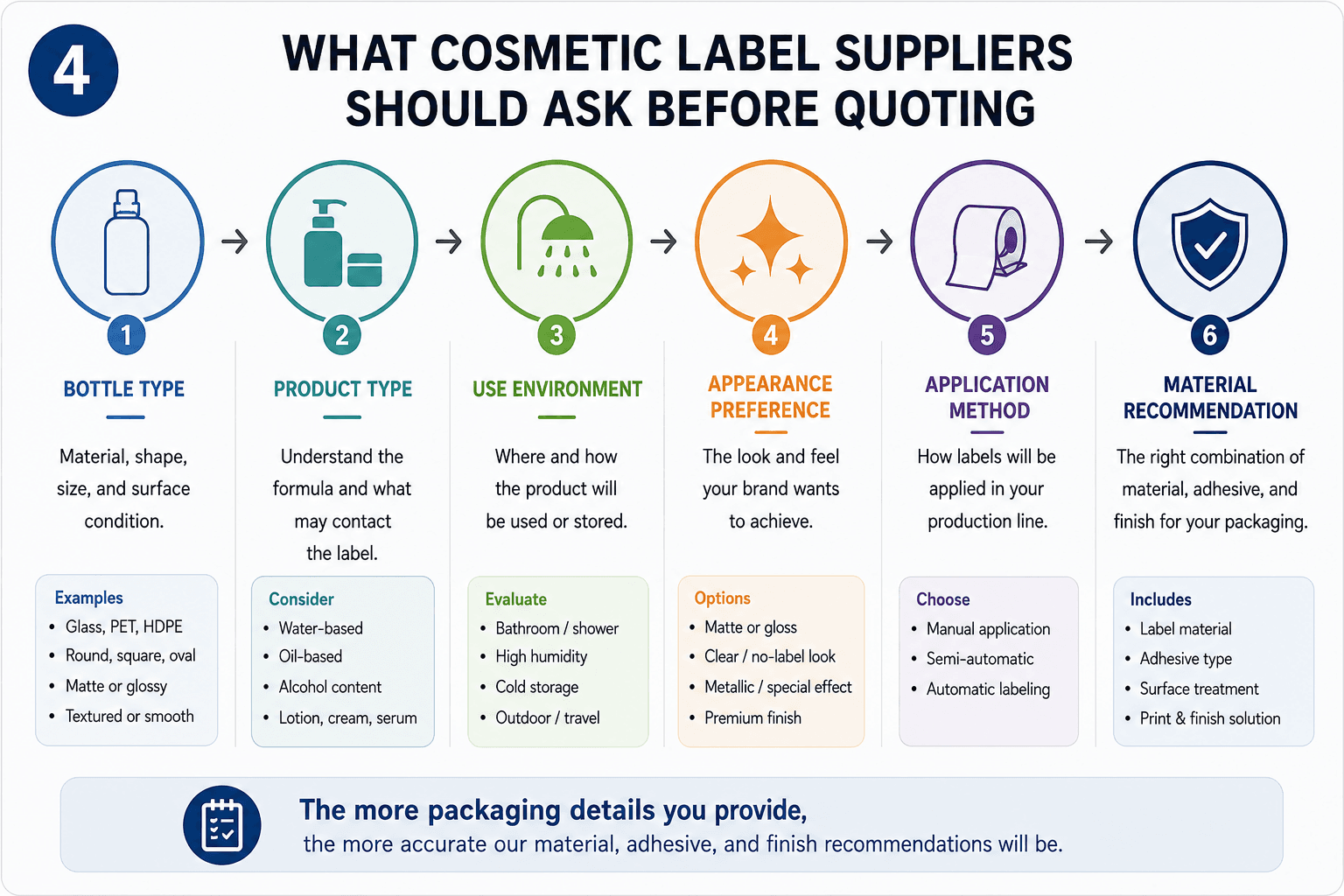
A supplier who understands custom label work should not stop at size, quantity, and artwork.
Before quoting waterproof cosmetic labels or oil resistant labels for skincare bottles, they should also ask:
- What product is in the package?
- What is the bottle material?
- Is the container rigid, round, tapered, or squeezable?
- Will the label face moisture, oils, or both?
- Is the package used in a bathroom or a dry shelf environment?
- Does the brand want a clear look, white film, matte finish, or decorative effect?
- Is the label applied by hand or machine?
- Is there a bottle sample, dieline, or container photo available?
That is not us being difficult. That is just us trying to do the job properly so the buyer does not get a headache later.
If the supplier does not know the bottle material, the use environment, the application method, and the surface shape, the first number is usually only a rough estimate.
That is especially true for clear cosmetic labels, facial oil bottles, and curved bottle projects where the wrong assumption tends to show up late and cost more to correct.
In our experience, once the customer can send four things early, the whole job gets easier: bottle photo, label size, product type, and use environment. Add a sample bottle or dieline, and the discussion gets better fast. If the SKU is also being prepared for retail systems across markets, teams sometimes have to cross-check barcode and product data structure against GS1 standards as well. Without that, a lot of first-round quotes are only educated guesses.
Common Mistakes Buyers Make on Cosmetic Label Projects
The first mistake is using waterproof as the only requirement.
It sounds specific, but it usually is not specific enough to choose the right structure.
Other common mistakes include:
- choosing material based on appearance alone
- deciding on clear labels before discussing edge performance
- ignoring oil residue on serum and lotion bottles
- assuming one material will work equally well across shampoo, lotion, and facial oil packaging
- sending artwork before sending container details
- testing a label in a dry office and assuming the job is safe for bathroom use
One common scenario is easy to recognize. The team approves the design, likes the bottle, signs off the clear look, and only later mentions that the product is a facial oil bottle or a bathroom-use lotion bottle handled every day with damp or oily hands.
At that stage, the artwork is already moving faster than the packaging decision.
That is usually where wasted time begins.
Another common mistake is pushing a clear label onto a bottle shape that does not really forgive it. On screen it still looks premium. In production, the edge starts telling the truth. Then the team spends another round of money trying to fix a material choice that should have been challenged much earlier.
The Better Buying Question Is Material Fit
The best cosmetic label is not the one with the strongest buzzword.
It is the one that fits the bottle, the product, the finish expectation, and the way the package will actually be used after production.
Procurement teams usually get better results once the discussion moves toward:
- Which bottle is this going on?
- Which residue risk matters most?
- Does the brand need BOPP, PET, clear film, or another construction?
- Will the label be handled lightly or constantly?
- Does the package need a practical durable finish or a premium transparent look?
Once those questions get answered early, material selection gets easier, quotes get tighter, and the label is less likely to fail for a reason that should have been obvious before production.
Say it more simply. Buyers do not need a prettier keyword. They need the right construction before they commit the job. If the project is ready for review, they can request a custom label quote before production starts.