In many custom sticker projects, buyers come to us with finished artwork but are still unsure whether kiss cut stickers or die cut singles fit the final product better. For cartoon brands, artist shops, and wholesale orders, that choice affects packing, presentation, counting, and how the stickers are actually sold.
Some orders work better as sticker sheets. Others need die cut singles or retail sticker packs. The artwork may stay the same, but the product format changes the job.
What Are Kiss Cut Stickers and When Are They Better?
Kiss cut stickers are cut through the sticker layer but not fully through the backing paper.
The practical result is simple: the sticker peels away from a larger backing piece instead of becoming a completely separate single.
This format is especially common when:
- one sheet contains multiple designs
- the buyer wants a sticker sheet instead of singles
- the stickers need to be easy to peel one by one
- the product is aimed at planners, journaling, stationery, or themed merch sets
For cartoon brands, kiss cut is often the cleaner answer when one concept includes several small expressions, poses, icons, or supporting illustrations. If the product is supposed to feel like a full mini collection rather than one hero sticker, kiss cut sheets are usually easier to understand and easier to pack.
They also reduce a lot of little operational headaches. A sheet is one SKU unit. One sheet is easier to count than ten tiny singles. It is easier to pack into a mailer. It is easier to insert into a subscription box. It is easier to hand out at an event without turning the table into a loose-paper mess.
For many stationery-style layouts and multi-design cartoon sheets, kiss cut stickers are easier to pack, easier to count, and easier for the end customer to peel.
What Are Die Cut Stickers?
Die cut stickers are cut all the way through the sticker and the backing so the finished product follows the outer shape of the design.
This is the format people usually imagine first when they think about custom cartoon stickers, mascot stickers, or hero character merch.
It works well when:
- one design needs to stand on its own
- the sticker is sold individually
- the outer silhouette is part of the product appeal
- the brand wants the sticker to feel like a finished merch piece
Die cut is usually the stronger option for:
- brand mascot stickers
- school or club mascots
- sports team character stickers
- one-design giveaway pieces
- convention merch singles
The silhouette matters here. The sticker itself needs to feel complete.
Kiss Cut vs Die Cut Stickers: The Main Differences
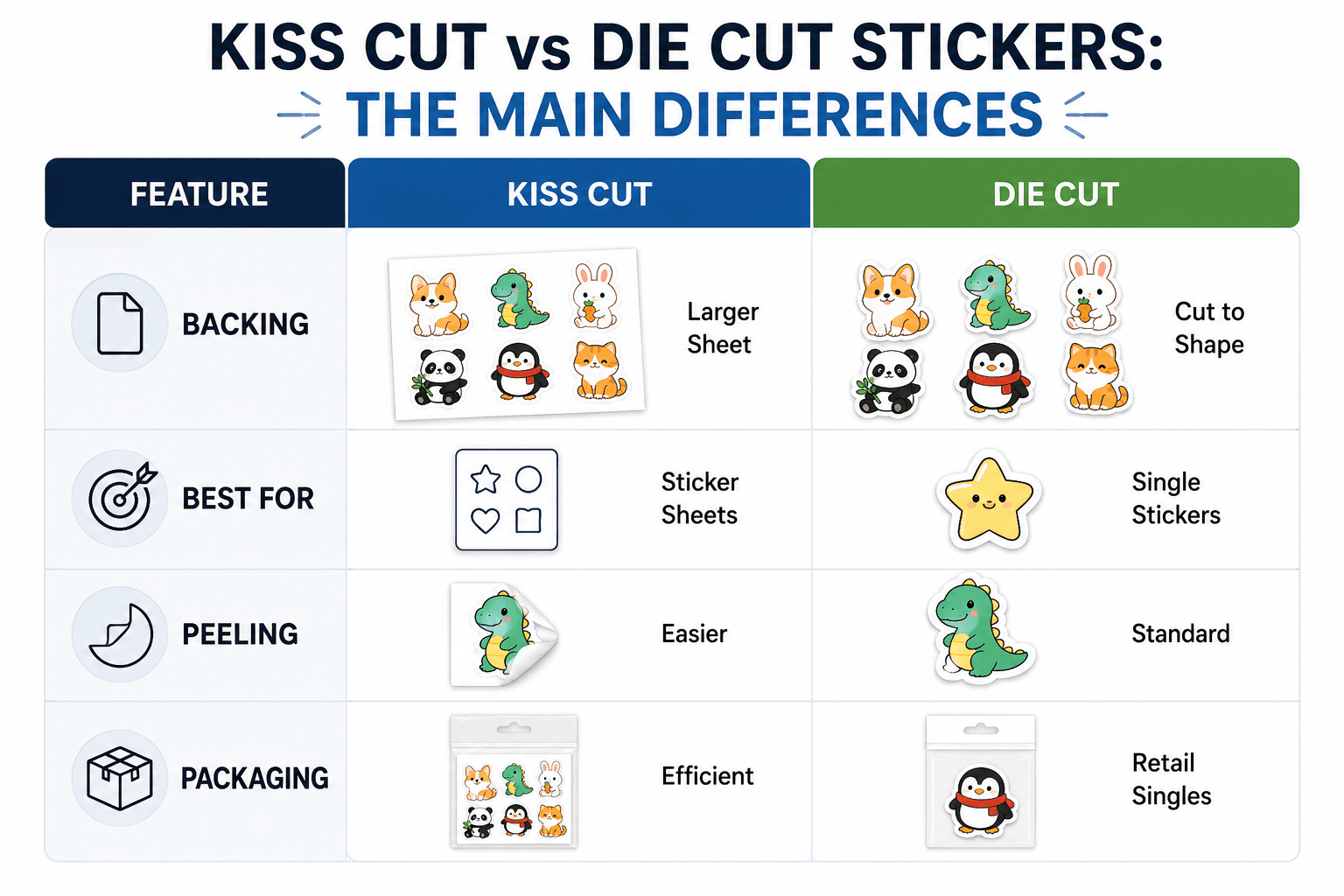
This comparison gets much easier once the buyer stops thinking only about cutting method and starts thinking about final product format. Kiss cut is usually better when the product is a collection. Die cut is usually better when the product is a single.
Which Format Works Better for Cartoon and Character Stickers?
Cartoon and IP-style sticker orders are rarely just about one sticker type. They usually sit somewhere between merch, packaging insert, gift item, and retail-ready product. That is why the same artwork family can lead to completely different format decisions.
For artist sticker sheets
If one theme includes multiple characters, small icons, speech bubbles, expressions, props, or decorative add-ons, kiss cut sheets usually win.
A lot of artist shops and stationery-style brands do better with kiss cut sticker sheets when the customer expects a themed layout. In those cases, die cutting every small icon into its own single usually creates more sorting, more packing work, and more cost for no real sales benefit.
For mascot stickers
If the product is one main mascot, one logo character, or one strong illustration that needs to stand alone, die cut is usually the better answer.
That is especially true for:
- brand mascot stickers
- school or club mascots
- sports team character stickers
- one-design giveaway pieces
- convention merch singles
The silhouette matters here. The sticker itself needs to feel complete.
For retail sticker packs
Many buyers searching for a sticker format are really deciding whether the final product should be one sticker sheet, multiple die cut singles, or a retail-ready sticker pack.
If you are selling packs, die cut singles usually make more sense because the product becomes a merch bundle. The customer opens the pack and gets several separate finished stickers. That feels more like a collectible product.
Kiss cut can still work in retail, but the format is different. It feels more like stationery, planner, or art-sheet merch.
For packaging inserts and promotional giveaways
Both can work. The right choice depends on the job.
If the goal is clean insertion into orders and easy multi-design presentation, kiss cut sheets are often more practical. If the goal is one eye-catching single sticker dropped into a parcel or handed out at a booth, die cut usually performs better.
One is not more premium by default. The use case decides it.
When Wholesale Buyers Should Choose Kiss Cut Stickers
Wholesale buyers should lean toward kiss cut when:
- several designs belong on one sheet
- the order is for planner, stationery, or themed cartoon collections
- the customer wants simpler counting and packing
- the stickers are part of a gift box, insert set, or sampler
- the order needs lower handling complexity than sorting many separate singles
This is often the smarter choice for schools, club packs, event kits, themed stationery lines, and artist sets where the value comes from the full page concept.
From a packaging point of view, sheets are easier to manage than piles of tiny singles. A5, A6, and other compact custom sheet sizes are common because they pack cleanly, count easily, and fit flat mailers without much argument from the fulfillment side.
When Wholesale Buyers Should Choose Die Cut Stickers
Wholesale buyers should lean toward die cut when:
- the sticker is sold as a single item
- each character is a separate merch piece
- the design silhouette is part of the appeal
- the order needs stronger individual retail presentation
- the stickers will be packed into custom sticker packs
- the brand wants giveaway singles, mascot stickers, or logo stickers
For B2B buyers, die cut usually makes more sense when the sticker itself is the SKU, not just part of a page.
If the customer is buying 5,000 pieces of one mascot design for retail, there is usually no reason to force that into a kiss cut sheet just because sheets sound efficient. That is the wrong product structure for the job.
This is also where packing details matter. Some buyers want plain singles in bulk. Others need 5 pcs per pack, 10 pcs per pack, or a backing card so the sticker set can hang or sit like a finished retail item. Those details affect labor, packing cost, and how clean the final product feels.
What About Sticker Sheets and Sticker Packs?
This part matters because buyers often use the wrong words when they first inquire.
A sticker sheet is usually built on a kiss cut format. Multiple stickers sit on one larger backing sheet.
A sticker pack is usually a bundle of separate stickers, often die cut singles, grouped into one retail-ready product.
If your cartoon brand is selling themed planner stickers, journaling sheets, grouped mini characters, or matching decorative sets, then sticker sheets are often the natural fit.
If your brand is selling collectible character singles, mascot stickers, retail merch bundles, or event-ready or ecommerce-ready packs, then sticker packs usually make more sense, and die cut singles are often the better base format.
A lot of confusion disappears once the buyer stops asking “kiss cut or die cut?” and starts asking “sheet, single, or pack?” If the team is also comparing layout standards or merchandising options, even the sticker platforms themselves explain the difference between sticker sheets and singles in similar terms.
Best Materials for Cartoon Stickers
Cut format is only part of the job. Material still matters.
For most cartoon sticker orders, white vinyl with matte or gloss lamination is the safest starting point. It works well for character stickers, mascot stickers, sticker packs, and ecommerce inserts. If the buyer wants a more collectible look, holographic vinyl can work well for limited-edition designs. For indoor stationery sheets, paper stickers may be enough, but for wholesale merch or giveaways, vinyl is usually more reliable because it handles friction, mailing, and daily use better.
The usual material conversation looks like this:
- White vinyl: the most practical starting point for merch, inserts, and wholesale runs
- Clear vinyl: useful when the artwork and product concept actually benefit from transparency
- Holographic vinyl: better for collectible IP, anime-style drops, and premium small-batch merch
- Paper stickers: acceptable for lower-cost indoor sheets, but less forgiving in transit and handling
Finish matters too. Matte lamination is common when the brand wants a softer printed look. Gloss lamination usually gives more pop and can hold up better when the stickers are handled repeatedly. Some buyers ask for UV coating, but on a lot of cartoon sticker work, a clean vinyl plus proper lamination matters more than fancy-sounding finishing terms.
And before bulk production, a sample is worth it. Especially if the order includes multiple character sizes, a custom cutline, or a retail pack format that has to look consistent across the full set. It is better to catch a weak cutline or awkward peel shape in sampling than in 10,000 finished pieces. Even large ecommerce platforms still publish updated buyer guides in Shopify’s sticker format guide because buyers keep running into the same decision at order stage.
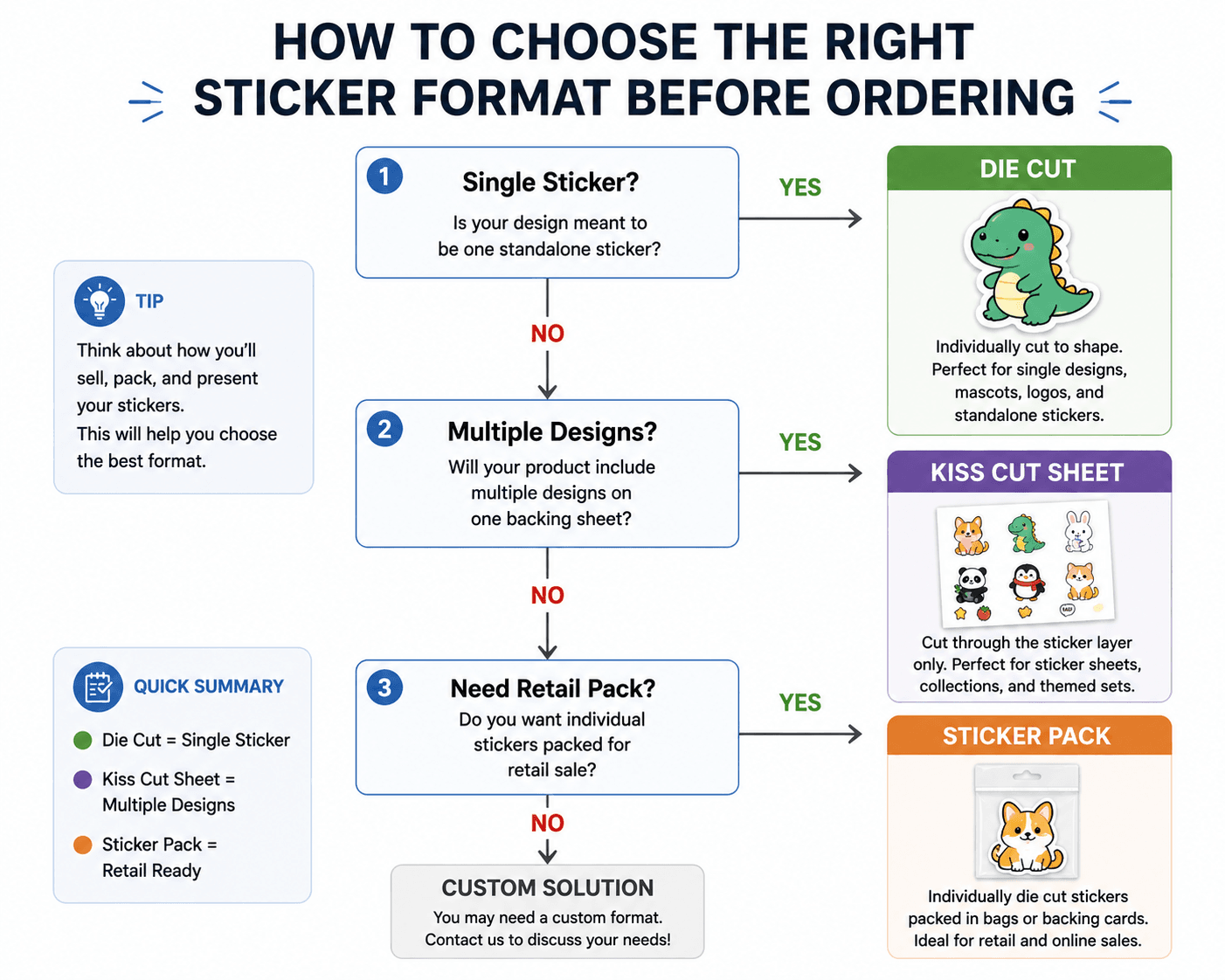
How to Choose the Right Format Before Ordering
Before placing a sticker order, buyers should answer these questions:
- Will the stickers be sold as singles or as a sheet?
- Is the customer an artist shop, a merch brand, or a wholesale buyer?
- Does the product need a strong individual outline?
- Does easy peeling matter?
- Is the order meant for planner use, stationery use, merch packs, or giveaways?
- Will the stickers be shipped loose, packed into sets, or inserted into retail packaging?
- Is waterproof vinyl needed?
If those answers are still fuzzy, the order is not ready for a confident format decision yet.
That is normal. But it is better to slow down there than to approve the wrong structure and fix it later.
Common Mistakes Buyers Make
The first mistake is assuming kiss cut is just a cheaper version of die cut. It is not.
The second mistake is assuming die cut is always more premium. Also not true.
Other common mistakes:
- treating a sticker sheet like a single-sticker product
- choosing singles when the real product should have been a themed sheet
- deciding format before deciding how the stickers will be sold
- quoting wholesale orders before the packing method is clear
- ignoring how much handling and counting separate singles creates
- sending raster artwork when the cutline really needs a clean vector file
- waiting until after pricing to explain that the order also needs backing cards or pre-packed sets
One version of this shows up all the time: the customer sends over six small cartoon characters and asks for a wholesale quote, but has not yet decided whether those six designs are supposed to be one sticker sheet, six die cut singles, or a retail-ready sticker pack. At that stage, the cutting format is not the only missing answer. The product structure itself is still undefined.
That is why two quotes for “the same stickers” can look completely different. They are not always the same product.
If you already know the artwork, quantity, and target format, the fastest next step is to request a custom sticker quote with the sheet size, single size, material preference, and packing plan included up front. If your project also includes custom label printing, include those specs in the same brief.