Sourcing a label that must feel like textured paper but still carry a glossy spot UV highlight raises a predictable set of questions. Can spot UV be used on textured paper? Does the finish make the label waterproof? Which base material fits best?
The short answer is that spot UV can be used on some textured papers, but it depends on texture depth, UV coverage, detail size and production method, and it should be confirmed on a proof or sample. The answer on water is firmer: spot UV does not make a textured paper label waterproof. Water resistance comes from the whole construction and the real exposure, not from a decorative finish on its own.
Water behaviour is the part buyers most often misread. A glossy spot UV area is a finish on selected parts of the surface; it is not a material change. Whether a label copes with moisture depends on the face stock, ink, coating or laminate, adhesive, container surface and the actual exposure.
That is why the word “waterproof” produces so much back-and-forth during quoting. Light splashes, condensation, refrigeration, repeated handling and immersion are different conditions, and they do not all point to the same material.
This guide is written for that quotation stage. It explains where textured paper and spot UV can work together, when BOPP or vinyl may be the better starting point, and how to prepare artwork, proofs and a quote request so the answer you get is specific to your package.
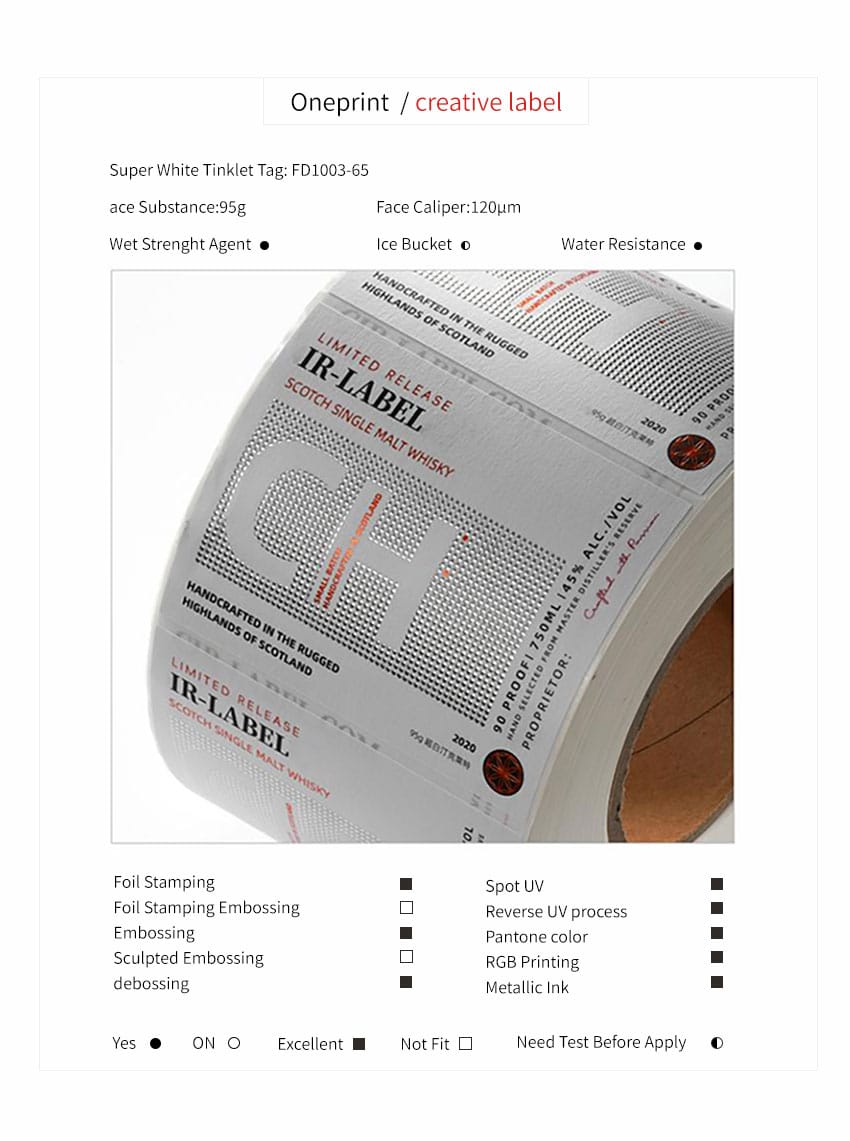
The finish only reads as intended when the surface underneath supports it, so it helps to look at the materials before comparing specifications.
With that reference in mind, the next section moves from the surface itself to the decisions a buyer has to make before ordering.
Why Textured Paper and Spot UV Need Careful Planning
Textured paper is chosen for its physical surface. Linen, felt, cotton, waffle and laid patterns can make a package feel different before a buyer reads a single word.
Spot UV is chosen for the opposite reason. It places a glossy coating on selected areas, usually a logo, border, illustration or product name, to create contrast against a matte or textured base.
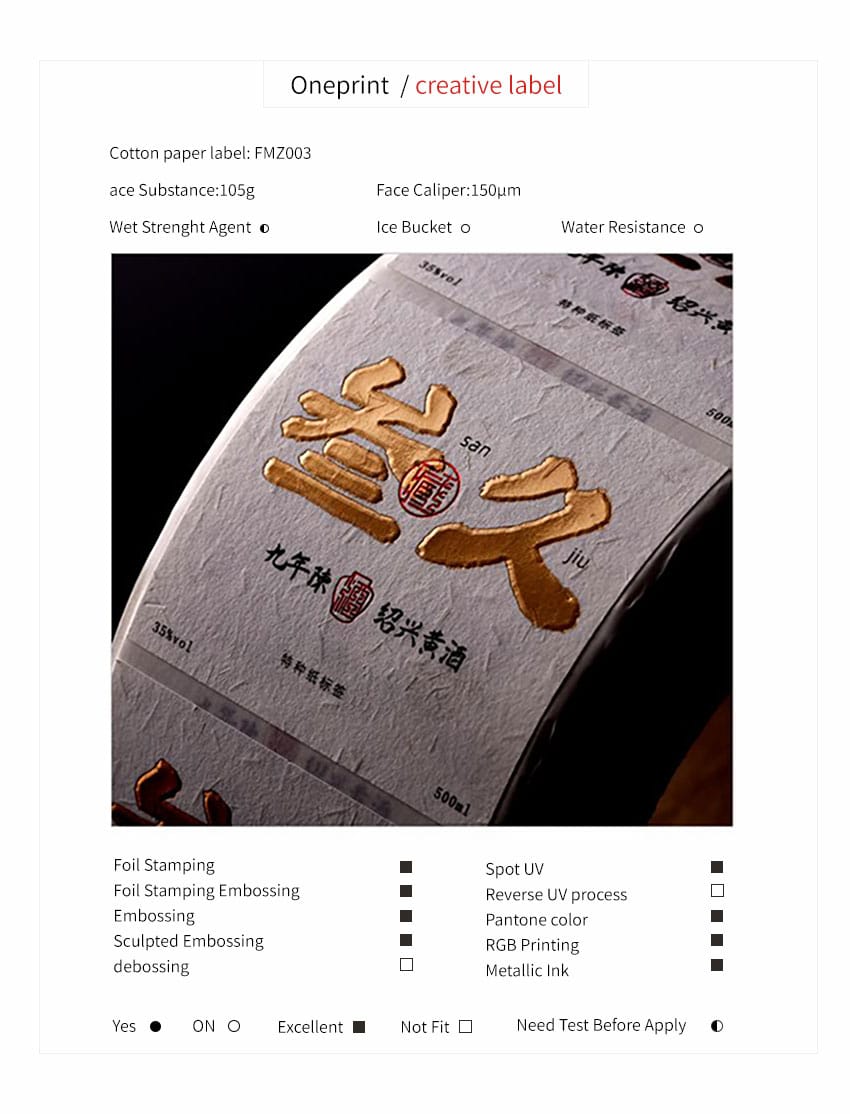
The two effects do not always behave the same way together. A textured face has peaks and valleys, so a spot UV layer applied across it may not look as even as it would on smooth coated paper or film. Fine details can lose definition, and the visible edge of the coating may follow the texture instead of appearing flat.
That does not make spot UV impossible on textured paper. It means the design, texture depth, coating area and production method have to be reviewed together. A large logo or broad highlight is usually easier to control than very small type, thin rules or dense UV patterns.
Before choosing a finish, review three variables:
- Texture depth and direction. A light, fine texture may behave differently from a deep, irregular texture. Directional patterns can also affect how a glossy area is perceived.
- Spot UV geometry. Large, simple shapes are usually easier to review than tiny text, narrow lines and complex overlapping masks.
- The label’s use environment. A dry candle box, a wine bottle in a cellar and a chilled bottle handled with condensation do not create the same material requirement.
Record these in the quote request. A material name on its own is not enough to select a reliable label construction.
Can Spot UV Make a Textured Paper Label Waterproof?
No. Spot UV is a decorative and protective finish for selected areas, and it should not be treated as a universal waterproof specification for a paper label.
The label’s moisture behaviour depends on the face stock, ink, coating or laminate, adhesive, container surface and exposure conditions.
A buyer who needs a tactile paper look may be considering a varnish, laminate or another protective treatment instead of spot UV alone. That choice still has to be checked against the actual use. Light splashes, condensation, refrigeration, an ice bucket, repeated handling and immersion are not the same requirement.
If moisture resistance is the main priority, compare paper and film constructions rather than asking only whether a finish can be added. OnePrint’s custom brown kraft label page describes the trade-off directly: kraft paper supports a natural tactile look, but it is not waterproof like a film label. A protective finish may help with everyday handling and light moisture, while suitability still depends on the product and its use.
When Film Materials May Be the Better Starting Point
Film-based materials such as BOPP or vinyl may suit projects that face regular condensation, wet handling, outdoor exposure or a surface that needs a more conformable face stock.
That does not make film universally better. It shifts the balance between tactile appearance, print surface, flexibility, moisture exposure and application behaviour.
For a clear or no-label look, compare the project with custom clear labels. For a more industrial or outdoor requirement, review custom vinyl labels. Both are starting points, not substitutes for a project-specific material decision.
Once the moisture question is separated from the finish question, the material choice usually becomes clearer. The sample below shows how a labelled surface can look when finish and base are planned together.
With the technical constraints set out, the next section turns to comparing the three common starting points before a quote is requested.
How to Choose Between Textured Paper, BOPP and Vinyl
The material should be selected from the package and its use conditions outward, not from a finish name inward. Use the comparison below as a first screening tool.
| Requirement | Textured paper | BOPP or other film | Vinyl |
|---|---|---|---|
| Main visual strength | Tactile, natural or crafted surface | Smooth, clear or metallic appearance | Flexible film for industrial or irregular applications |
| Best first question | Is touch and paper character central to the package? | Is moisture handling or a clean film surface important? | Is the surface textured, curved or exposed to a demanding environment? |
| Spot UV discussion | Review texture depth, UV area and detail size | Usually easier to define on a smoother face | Confirm surface, laminate and intended use before choosing a finish |
| Moisture discussion | Do not assume waterproof performance; test the construction | Confirm film, adhesive and finish for the application | Confirm film, adhesive, laminate and exposure conditions |
| Application discussion | Check curvature, paper stiffness and edge behaviour | Check bottle, container and application method | Check curvature, low-surface-energy plastics and machine feeding |
This table is a decision aid, not a performance guarantee. It should be followed by a review of the container, label dimensions, artwork, adhesive and handling conditions.
A Practical Decision Sequence
Start with the package surface. Glass, coated metal, HDPE, corrugated board and flexible pouches can each require different adhesive and face-stock decisions.
Then describe the environment: dry retail shelf, bathroom, refrigerator, outdoor equipment, chemical handling or another condition.
Next, separate appearance requirements from functional ones. “Natural tactile texture” is an appearance requirement; “survives condensation” is a use requirement. They may be compatible, but they are not the same specification.
Finally, decide which feature is non-negotiable. If texture is the brand’s main differentiator, keep the paper and simplify the finishing or the exposure claim. If moisture resistance is the primary risk, start from a film construction and add decorative finishing only after the base material is suitable.
An Anonymous Buyer Scenario: When Finish Requirements Conflict
One anonymised inquiry in OnePrint’s customer case library involved a buyer who wanted a textured paper label with spot UV and water resistance. The recorded discussion identified a process conflict: the requested combination could not be treated as three independent checkboxes.
The solution discussion considered keeping the textured paper while dropping the UV requirement, or moving the material toward vinyl when water resistance mattered more.
This record was a quotation clarification, not a completed success case. It does not prove a finished label’s performance, a confirmed order or a customer result. Its value is the purchasing lesson: a supplier should explain the trade-off before the buyer approves artwork and commits to a production route.
The same logic applies to other finishing combinations. If a designer asks for deep texture, very small UV lettering, heavy embossing and high moisture resistance on one label, the supplier should identify which requirements can coexist and which need testing or adjustment. A clear answer before production is more useful than a confident answer that ignores the construction.
How to Prepare Artwork for Spot UV on Textured Labels
The artwork should show the base print and the spot UV area as separate, unambiguous information. The production team needs to know which elements are printed, which receive UV, and which need foil, embossing or another finish.
For the UV layer, use a clean vector mask where possible and avoid sending a raster screenshot as the final finishing instruction. Check small type, thin rules, narrow gaps and registration-sensitive details at the actual label size. If the UV highlights a logo, the mask should make the logo boundary obvious rather than relying on a verbal explanation.
A practical preflight checklist includes:
- Final label size and dieline;
- Material name or requested texture reference;
- Print artwork in an editable vector format or production-ready PDF;
- Separate spot UV layer or clearly named finishing layer;
- Foil, embossing and white-ink areas marked separately when applicable;
- Bleed, safe area and cut-line information;
- Container type, surface and curvature;
- Application method and roll or sheet requirements;
- Storage, handling and moisture exposure;
- Proof or physical sample requirement.
A public spot UV artwork checklist from Namecards.com.sg makes a similar point about separate finishing information, vector artwork and checking the UV separation before production. Treat public artwork guides as general preparation references; the final file instructions should come from the supplier making the labels.
What to Check in a Proof or Sample
A proof is useful for artwork, layout and colour review, but a screen proof cannot answer every application question. If the project carries a real material or adhesion risk, request a sample or agree the test conditions before production.
Inspect the following points:
- Texture and gloss contrast: Does the UV area create the intended visual contrast without becoming uneven or muddy?
- Small details: Are fine type, thin lines and logos still readable at the actual label size?
- Color on the base: Does the ink appearance match the expected effect on the selected paper or film?
- Finishing registration: Do UV, foil, embossing and the cut line align with the artwork?
- Application fit: Does the label sit correctly on the real bottle, jar, box or pouch?
- Handling conditions: If condensation, refrigeration, oil, cleaning or repeated handling matters, test the label under the relevant conditions.
Do not treat a sample as proof of every future use condition. A sample supports a defined review. The buyer remains responsible for confirming the final product content, approved artwork and any market-specific requirements.
Common Mistakes When Ordering Textured Paper Labels
Most avoidable label problems start before production, in the quote request. These are the patterns that cause the most rework.
Treating Waterproof as a Finish
A glossy spot UV area does not turn paper into a waterproof label. Ask what face stock, protective layer and adhesive are being proposed, then describe the actual exposure.
Choosing Texture Before Checking the Container
A texture that looks right on a flat sample may behave differently on a tight curve. Provide the bottle, jar or package dimensions and, where possible, a physical sample or accurate reference.
Sending Only a Final Design File
A design file cannot tell the supplier whether the label will be hand-applied, machine-applied, refrigerated, exposed to oil or handled outdoors. Those details affect the quote and the material discussion.
Combining Every Finish in One Request
Texture, spot UV, foil, embossing, laminate and high moisture resistance can all look attractive, but adding more effects does not automatically improve the label. Define the purpose of each finish and remove any effect that does not support the package or the customer decision.
FAQ: Textured Paper, Spot UV and Waterproof Labels
Can Spot UV Be Used on Textured Paper Labels?
It can be considered for some textured papers and designs, but the result depends on texture depth, UV coverage, detail size and production method. Confirm the combination on a proof or sample.
Are Textured Paper Labels Waterproof?
Textured paper should not be assumed to be waterproof. Moisture suitability depends on the complete construction and the actual environment. If regular water or condensation is expected, compare a suitable film option.
What Is the Difference Between Textured Paper and Vinyl Labels?
Textured paper prioritises tactile character and a paper-based visual effect. Vinyl prioritises a flexible film construction for selected outdoor, industrial or irregular-surface applications. The right choice depends on the package, the environment and the required appearance.
Can Foil and Spot UV Be Used on the Same Label?
The combination may be possible, but the artwork, material, registration and detail size must be reviewed together. Ask for a proof rather than assuming every finish can be placed anywhere.
What Should I Send When Requesting a Quote?
Send the label size or dieline, package type, material preference, surface condition, application method, quantity, artwork status, desired finishes and the environment where the label will be stored or used.
Request a Material and Finishing Review
If you are deciding between textured paper, BOPP and vinyl, send the label size, package type, artwork, desired finish and actual use environment. OnePrint can review the production conditions, explain the material and finishing options, and confirm what should be tested before the final run.
A useful quote request needs more than a design file. Include a photo or description of the package surface, whether the label is applied by hand or machine, the expected exposure to water or condensation, and the finish hierarchy: which requirement is essential, which is preferred, and which can be dropped if the construction becomes impractical.
If you do not have a physical bottle or package sample, say so. A drawing or photo is a useful starting point, but final placement, curvature and adhesion still need confirmation. If the label is for chilled service, outdoor use or repeated handling, describe the actual routine instead of a single word such as “waterproof”. You can also compare custom foil labels for metallic and tactile finishing, review custom label printing options or request a custom label quote.