Quick answer: most folded label failures start before printing
Folded labels are useful when a package needs more instructions, languages, warnings, or brand content than a single label face can hold. They are also more sensitive to artwork and application errors. A folded label can look correct as a flat PDF but fail after production because the panel order is wrong, a fold line crosses a barcode, the adhesive is placed in the opening area, or the folded size does not fit the package surface.
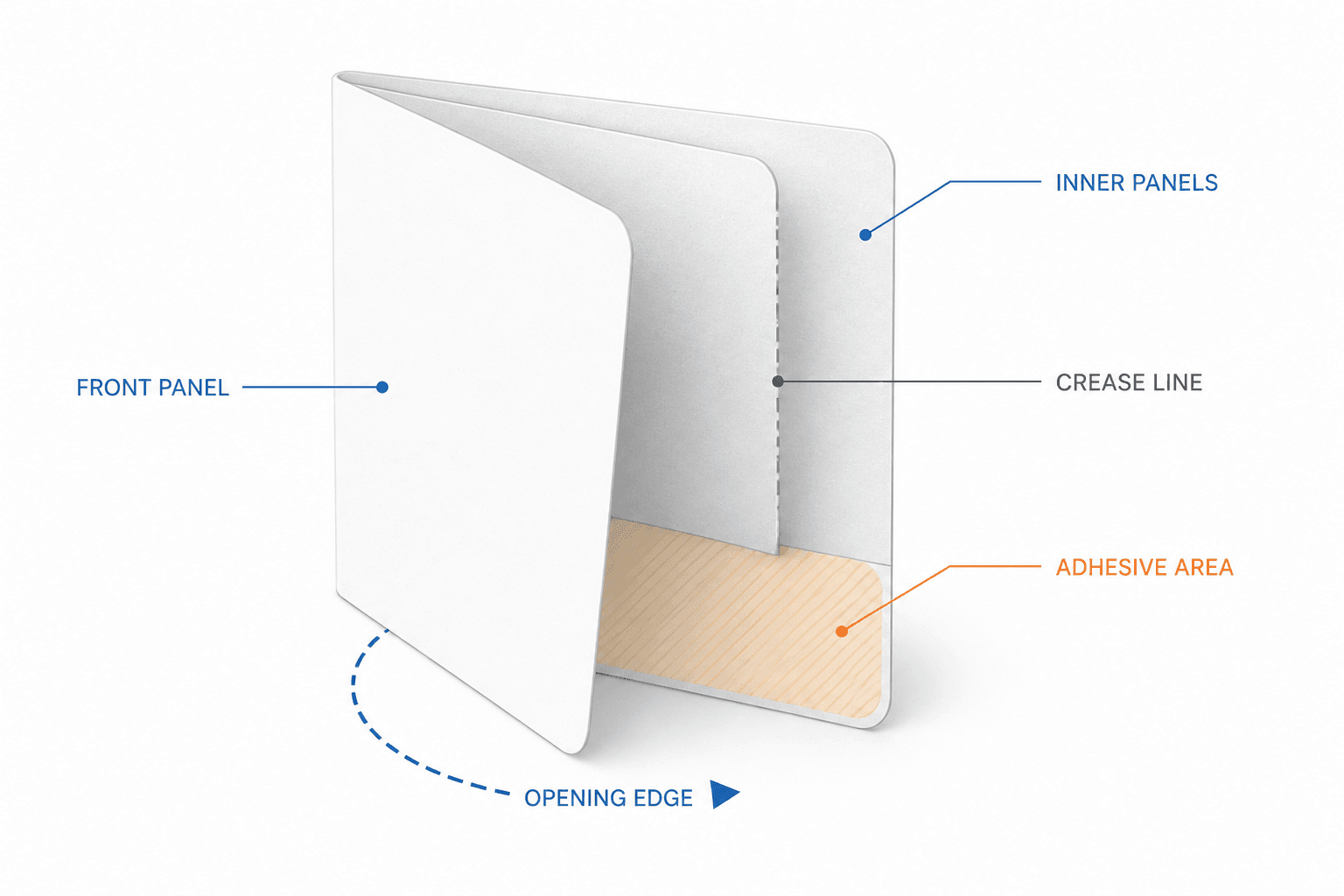
The safest workflow is to approve the structure before approving the artwork. Confirm the folded size, unfolded size, number of panels, reading direction, fold lines, adhesive and non-adhesive zones, opening edge, label orientation, and application method. Then check a physical sample on the real or representative package. A supplier can help review production conditions, but the brand owner remains responsible for final copy, artwork approval, product information, and market-specific compliance.
When folded labels solve a real packaging problem
A folded label is not simply a larger sticker folded in half. It is an information-carrying structure with a defined opening action. The front panel may carry the product name and brand identity, while the inside panels provide instructions, ingredients, warnings, multilingual copy, usage details, traceability information, or promotional content.
This structure is most useful when the package surface is limited but the information cannot be reduced without damaging readability. Small bottles, tubes, jars, chemical containers, health products, cosmetics, export packaging, and promotional packs can all create this tension. The exact solution depends on the product, package geometry, information requirements, and application process.
A folded label may also help a brand avoid adding a separate leaflet or changing the main package design. That does not mean it automatically replaces a legally required insert or satisfies a market rule. If the label carries regulated information, the content and layout must be checked against the requirements of the destination market before production.
A common anonymous inquiry pattern
In one anonymous inquiry, a buyer asked about a 65 × 100 mm folded double-sided label with coated paper, full-colour printing on both sides, foil on both sides, and a crease through the middle. The request sounded complete, but it still left important production questions unanswered: Was the size the folded size or the flat size? Which panels needed foil? Which surface would receive adhesive? Would the label be opened repeatedly? Was it supplied as sheets or rolls? Was the fold intended for hand application or a label application line?
The lesson is not that this structure cannot be produced. The lesson is that a material list and a finished size do not define a folded label well enough for reliable quoting. The missing information is structural.
Folded label structures: clarify the terms before quoting
Buyers and suppliers do not always use “folded label,” “booklet label,” “multi-layer label,” and “peel-and-reveal label” in exactly the same way. Before comparing prices, describe the physical action and the number of readable surfaces.
A folded label normally uses a crease or hinge so the label opens and closes. Some suppliers also use “fold-out labels” for structures that open to reveal additional panels. A booklet label uses a small booklet or leaflet attached to an adhesive base. A peel-and-reveal label uses a top layer that lifts to expose printed information underneath and may be designed to reseal. A multi-layer label is a broad term that may include folded, peelable, or laminated constructions.
These structures have different risks. A peel-and-reveal label depends heavily on the opening corner, hinge, reseal behaviour, and adhesive pattern. A booklet label depends on the page sequence, spine or hinge, cover alignment, and panel thickness. A folded label depends on the crease position, fold direction, closure, and the way the structure sits on the package.
Questions to put on the quotation request
Instead of writing only “custom folded labels,” provide answers to these questions:
- What is the finished folded size?
- What is the fully unfolded size?
- How many panels or pages are required?
- Which panel is the front cover?
- Where is the fold or hinge?
- Which area is adhesive?
- Which area must remain open or non-adhesive?
- Does the label need to be resealed?
- Is it applied by hand or by equipment?
- Will it be supplied as sheets, fan-folded pieces, or rolls?
A simple sketch is often more useful than a long email because it shows the intended action. The sketch is not a substitute for a final dieline, but it gives the supplier enough information to identify structural questions before pricing.
| Structure | Best fit | Main risk |
|---|---|---|
| Folded label | A package surface that must carry more information than one label face, using a crease or hinge to open and close | Confirm the crease location on a closed and open proof |
| Booklet label | Content organised as a small booklet or leaflet attached to an adhesive base | Number every panel before artwork approval |
| Peel-and-reveal label | A top layer that lifts to expose printed information underneath and may reseal | Mark adhesive and non-adhesive zones clearly |
| Multi-layer label | A broad term for folded, peelable, or laminated constructions | Confirm the opening method and application format |
Fold lines and panel order: the most common artwork problems
Fold lines are functional boundaries, not decorative marks. They determine what the reader sees when the label is closed, what is hidden inside, and whether the folded structure closes cleanly. If the fold line is missing or placed incorrectly in the artwork, production may follow the file exactly and still produce a label that does not work as intended.
Every panel should be numbered on the working proof. The numbers do not need to appear on the final label; they are for checking the reading sequence. Mark the front, back, inside left, inside right, and any intermediate panels. For a roll-fed label, also mark the unwind direction and the leading edge. Without this information, a file can be rotated or imposed in a way that reverses one panel after folding.
Keep important content away from the crease. Small text, barcodes, QR codes, fine rules, foil details, and product illustrations can be damaged visually when they cross a fold. A fold also creates a change in angle, so a line that looks continuous on screen may not look continuous on the finished sample.
Build the proof around the physical sequence
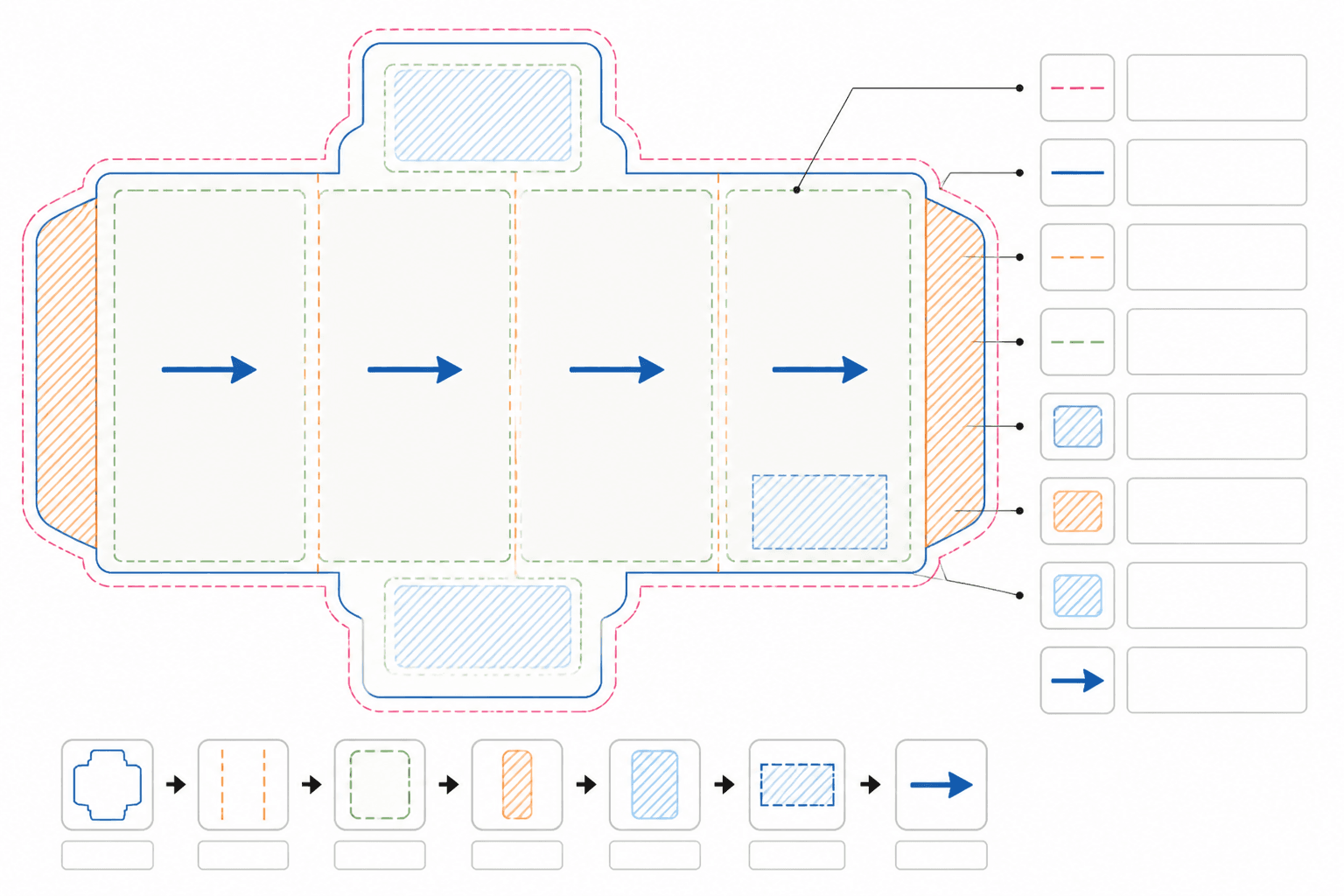
A reliable proof should show three views:
- The fully unfolded artwork with panel numbers and fold lines;
- The closed label showing the outside reading order;
- The opened label showing the inside reading order and adhesive relationship.
If the label wraps around a bottle, add a fourth view showing the package position. This helps identify whether the opening edge points toward the front, back, cap, seam, or a neighbouring label.
The proof diagram below shows the panel order, fold lines, bleed and safe area, and the adhesive and non-adhesive zones.
Adhesive zones, hinges, and opening edges
The adhesive pattern controls whether a folded label stays attached while still allowing the user to open it. A label may need a permanent adhesive base, a hinged area, a resealable panel, or a combination of adhesive and non-adhesive zones. These decisions should appear in the structural drawing, not remain as an assumption between the designer and printer.
A common failure occurs when the adhesive spreads into the opening area. The label then sticks shut, tears when opened, or leaves adhesive where the user expects a clean page. The opposite failure is also possible: the closure area does not hold well enough, so the panel lifts during packing, transport, or normal handling.
The package surface matters just as much. Glass, coated paperboard, plastic, metal, textured packaging, and flexible films do not provide the same surface conditions. Curves, seams, mould lines, recessed areas, dust, oil, condensation, and low application pressure can all change the result. A folded structure that works on a flat sample board may need a different adhesive pattern or hinge position on a small-radius bottle.
What to confirm before selecting materials
Provide the supplier with:
- The package material;
- A photo or drawing of the application area;
- Flat width and height of the available surface;
- Curvature or taper information;
- Application temperature and normal storage conditions;
- Whether the label must be opened repeatedly;
- Whether the package is filled, refrigerated, or exposed to moisture or oil;
- Whether application is manual or automated.
Do not treat a general material description as a performance guarantee. Paper, film, synthetic paper, adhesive, coating, and laminate should be selected for the specific package and use conditions, then checked through sampling where needed.
Double-sided printing and foil: why the visual brief needs more detail
Double-sided folded labels create another layer of coordination. “Print both sides” does not explain whether the back side is read through the fold, printed on a separate panel, or printed on the reverse of a carrier or leaflet. The file should identify every printable surface and its orientation after folding.
Foil on both sides also needs a practical discussion. Foil coverage, fine text, registration, foil colour, embossing, crease position, and the relationship between foil and fold lines can affect the final appearance. A buyer may want the same foil effect on every panel, while the production team may recommend reducing foil near the crease or changing the foil treatment on an inside panel to protect readability and registration.
This is where a flat mock-up can mislead the team. A screen rendering may show a clean metallic effect, but it does not show how the foil looks at a fold, how the material springs back, or whether the folded label closes flat. If the design includes small foil text, fine borders, embossing, or a heavy coverage area, request a proof that represents the relevant process rather than approving only a digital image.
Separate “must have” from “nice to have”
Before quoting, divide the brief into three groups:
- Must have: panel count, dimensions, language content, barcode, opening action, package position, and required material constraints;
- Preferred: foil on selected panels, colour targets, matte or gloss finish, special paper, and decorative details;
- Optional: embossing, spot UV, variable data, security elements, or promotional inserts.
List the must-have requirements first, so any lower-cost alternative can be judged against the same production needs.
Roll, sheet, and application format can change the design
The same folded label can have different production requirements depending on how it is supplied and applied. Sheet delivery may be suitable for manual application, sampling, or secondary packaging. Roll delivery may be preferred for a label application line, but it requires a defined unwind direction, core, roll diameter, spacing, and leading edge. Fan-folded or stacked formats may be used for certain manual or packaging operations, but they should be confirmed rather than assumed.
Ask how the label will be applied before the artwork is locked. A hand-applied label can allow more flexibility in orientation and opening position. An automated line may require consistent pitch, a specific web direction, a controlled fold position, and a structure that does not interfere with the applicator. The finished folded thickness may also affect feeding and separation.
If a buyer changes from sheets to rolls late in the project, the label may need a new imposition, new spacing, or a different fold orientation. That can affect both cost and timing. The most efficient approach is to tell the supplier the intended application method at the beginning, even if the final delivery format is still being evaluated.
A practical application test
Use a representative package and check the label in the actual position. Open and close it repeatedly, then inspect the edge after handling. If the package is tapered or curved, check the top and bottom edges rather than only the centre. If equipment will apply the label, run a controlled test with the intended direction and settings. Record what was tested so the approved sample has a clear reference.
A prepress and sampling checklist for folded labels
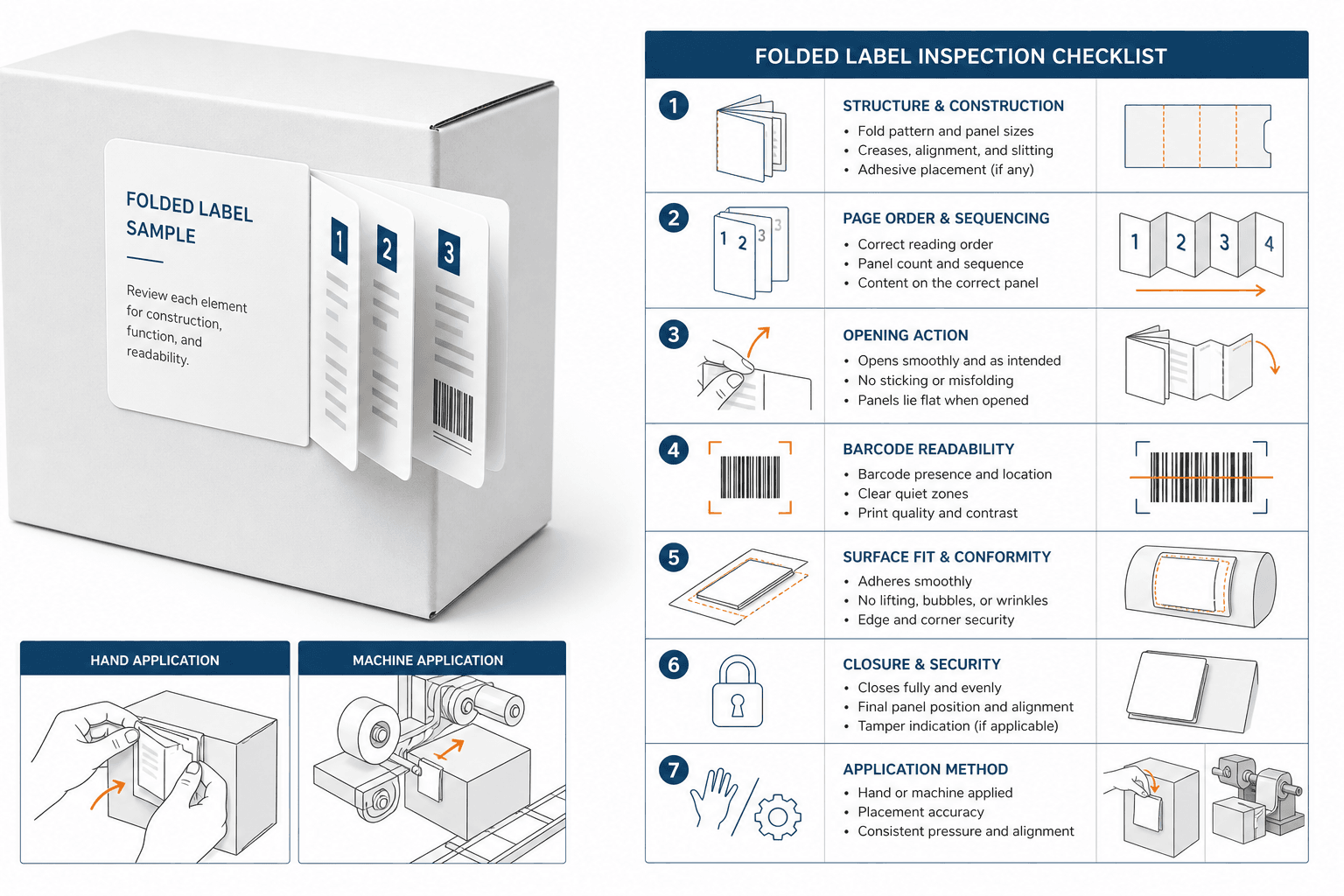
Before approving production, ask for a checklist or marked proof covering the following points:
Structure
- Folded size and unfolded size are both stated;
- Panel count and page order are numbered;
- Fold lines, bleed, and safe areas are visible;
- Front, back, inside, and outside surfaces are identified;
- Opening edge and hinge direction are clear.
Adhesive and package fit
- Adhesive and non-adhesive zones are marked;
- The label position on the package is shown;
- Curves, seams, closures, and nearby components are considered;
- The opening action has been tested on a representative surface.
Artwork and print
- Text remains readable after folding;
- Barcodes and QR codes do not cross a crease or adhesive area;
- Foil, embossing, UV, and colour requirements are separated by layer;
- Double-sided artwork is oriented correctly;
- The final file includes the correct bleed and safe margin.
Sample approval
- The sample uses the intended structure or a clearly labelled structural mock-up;
- The sample is checked closed, opened, and resealed if required;
- The final copy, languages, barcode, and legal information are approved by the brand owner;
- Any material or application limitation is recorded before the production order.
FAQ: common folded label troubleshooting questions
Are folded labels the same as booklet labels?
Not always. “Booklet label” usually refers to a small booklet or leaflet attached to an adhesive label base. “Folded label” is broader and may describe a folded or hinged structure. Confirm the physical construction rather than relying on the name.
Can folded labels replace a separate instruction leaflet?
They can provide a compact way to carry information, but whether they can replace a leaflet depends on the product and destination-market requirements. The brand owner must confirm the final regulatory and product content.
Can folded labels be supplied on rolls?
Some structures can be engineered for roll delivery, but the unwind direction, spacing, fold position, thickness, and application equipment must be reviewed. Do not assume that a sheet design can be moved to a roll without changes.
What is the most important file for a folded-label quote?
A marked structural drawing or dieline is usually more useful than a flat artwork file alone. It should show folded and unfolded sizes, panel order, fold lines, adhesive zones, opening edge, and application orientation.
Should I request a physical sample?
A sample is strongly recommended when the label opens, reseals, wraps around a curve, carries fine foil or embossing, or must run through application equipment. The sample should be checked on the real or representative package.
If your packaging also uses multi-panel or multi-page formats, our multi-layer labels purchasing guide explains how panel order, adhesive zones and formats are compared before ordering.
How to request a folded label review
Send the product or package photo, folded and unfolded dimensions, panel count, artwork or content list, material preference, adhesive requirement, application method, quantity, destination market, and any barcode or multilingual content. If some information is not final, mark it as pending instead of guessing. Reviewing the custom label printing options first also helps keep the brief aligned with realistic materials and finishing.
Contact OnePrintPack for a folded-label quotation and production review. A production review can start with the structure and information requirements; final material, adhesive, artwork, sampling, and delivery details should be confirmed for the specific project.
Source and risk notes
- The anonymous inquiry example in this article is used only to illustrate missing quotation information. It is not presented as a completed customer project or a performance result.
- Folded label structures, material suitability, adhesive performance, application compatibility, regulatory wording, and delivery timing require project-specific confirmation.
- OnePrintPack can review production conditions and artwork requirements, but the brand owner remains responsible for final product content, approved files, and market compliance.