Quick Answer: what are multi-layer labels?
Multi-layer labels are labels built with more than one printable or readable surface. The additional layer may peel back, fold out, open like a booklet, or reveal information underneath. They are useful when a package needs more instructions, warnings, languages, variable data, or product information than a single label face can hold.
The term is broad, however. A multi-layer label may be a peel-and-reveal label, a folded label, a booklet label, or another construction with multiple printable surfaces. These formats do not have the same opening action, adhesive pattern, thickness, or application requirements.
Before comparing prices, define the physical structure. State the folded or closed size, fully opened size, panel count, opening edge, adhesive zones, package surface, application method, and delivery format. A flat artwork file alone is rarely enough for a reliable multi-layer label quotation.
When multi-layer labels solve a real packaging problem
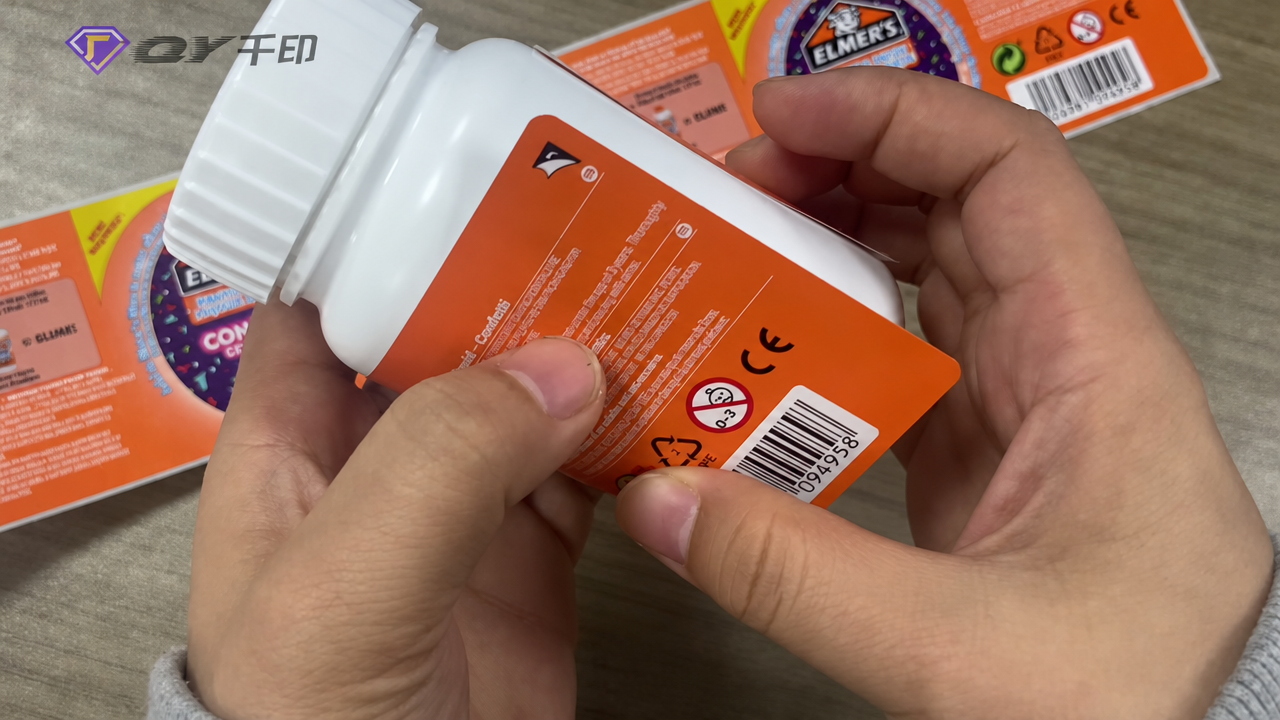
The main reason to specify a multi-layer label is usually limited package space. A bottle, tube, jar, pouch, or small container may not have enough surface area for all the information that must stay with the product. Reducing the copy may make the label less useful, while adding a separate leaflet may change the packaging process.
A multi-layer construction can organise information across several surfaces while keeping it attached to the package. Depending on the format, the outside layer may carry the product name and front-facing design, while the inside layer carries instructions, multilingual copy, warnings, usage details, traceability information, or promotional content.
This does not mean that a multi-layer label automatically replaces a required leaflet or satisfies a market rule. The brand owner remains responsible for the final copy, product information, market-specific requirements, and artwork approval. The printer can review production conditions and help identify structural questions, but should not be treated as the final regulatory authority.
Typical project signals
A multi-layer label may be worth considering when:
- A small package needs more readable information than one label face can hold;
- Several languages need to remain attached to the product;
- Instructions or warnings need to be available without changing the package shape;
- A variable code, serial number, or traceability field needs a defined position;
- The label must open for reading but remain attached after application;
- A brand needs multiple printable surfaces without using a separate insert.
The right structure depends on the package, the information sequence, the opening action, and the application process. The name of the format should come after those requirements, not before them.
Multi-layer labels, multi-ply labels, booklet labels, and folded labels
Buyers and suppliers do not always use these terms in exactly the same way. For a quotation, describe what the label physically does and how many surfaces must be printed.
Multi-layer labels
“Multi-layer label” is a broad description for a label with several layers or readable surfaces. It may include folded, peelable, booklet, or laminated constructions. Because the term is broad, it should be supported by a sketch or structural drawing.
Multi-ply labels
“Multi-ply label” often describes a label made from multiple plies or layers that provide additional information or a peelable construction. The exact meaning can vary by supplier. Ask whether the layers are folded, hinged, peeled, resealed, laminated, or attached as a booklet.
Peel-and-reveal labels
A peel-and-reveal label uses a top layer that lifts to expose information underneath. The opening corner, hinge, adhesive pattern, and reseal requirement are important. A small change to the non-adhesive zone can affect whether the consumer can open the label cleanly.
Booklet labels
A booklet label uses a small booklet or leaflet attached to an adhesive base. It is organised around page order, cover alignment, hinge or spine position, and the thickness of the folded booklet. If the project needs more details about booklet and folded structures, see the folded label artwork checklist.
Folded labels
A folded label opens through a crease or hinge and may expose one or more additional panels. The key checks are fold direction, panel order, closed size, open size, adhesive and non-adhesive areas, and application orientation.
| Structure | What the buyer should define | Common quotation risk |
|---|---|---|
| Peel-and-reveal | Opening corner, hinge, reseal requirement, adhesive zones, and printed layers | The top layer sticks shut or does not close as intended |
| Booklet label | Page count, cover, reading order, hinge or spine, and application base | Page sequence or cover alignment is unclear |
| Folded label | Fold line, panel order, closed/open sizes, and opening edge | The fold crosses important content or the closed label does not fit |
| Multi-ply label | Number of plies, opening action, layer order, and final thickness | The name describes the format too broadly for accurate pricing |
The information to include in a multi-layer label quote request
A quote request should describe both the label and the package. The following information helps a supplier identify structural questions before pricing.
1. Closed and fully opened dimensions
State the finished closed size and the fully opened size separately. If a booklet or folded panel is involved, include the width and height of each relevant panel. Do not assume that “label size” tells the supplier whether you mean the closed format, the flat dieline, or the applied footprint.
2. Layer or panel count
List the number of layers, plies, pages, or panels. If the label has a front cover, inside panels, back panel, or carrier layer, name them in the drawing. Panel numbers are for approval and do not need to appear on the final printed label.
3. Opening action
Explain how the user should access the information:
- Peel from a corner;
- Fold along a hinge;
- Open a booklet;
- Lift and reseal;
- Remove a top layer;
- Read through a transparent or partially open construction.
A short sketch can prevent several rounds of clarification.
4. Adhesive and non-adhesive zones
Mark the permanent adhesive area, hinge area, removable area, and any opening zone. If an area must remain free of adhesive, show it on the structural drawing. Do not leave the opening action as an assumption in the artwork file.
5. Package and application details
Provide the package material, surface shape, available label area, curvature, seams, recesses, and application method. State whether the label is applied by hand or by equipment. If it is applied on a line, include the desired delivery format and any known unwind or orientation requirements.
6. Content and data requirements
List the languages, instructions, warnings, barcode or QR code, variable data fields, serial numbers, and any content that must remain on a specific panel. If the data is not final, mark it as pending rather than allowing the artwork team to guess.
Artwork preparation: design for the open and closed views
A multi-layer label should be approved in more than one view. A flat design may look correct on screen while producing the wrong reading order after folding or peeling.
Prepare three approval views
A practical proof should show:
- The fully unfolded or separated artwork with numbered panels or layers;
- The closed or applied view showing the outside reading order;
- The opened view showing the inside sequence, adhesive relationship, and opening edge.
If the label wraps around a bottle or container, add a package-position view. This helps the team confirm whether the opening edge faces the front, back, cap, seam, or a neighbouring label.
Keep critical elements away from functional boundaries
Avoid placing small text, barcodes, QR codes, fine rules, important illustrations, foil details, or key claims directly across a fold, hinge, cut, or adhesive boundary. The change in angle can make a continuous line look broken. A crease can also reduce the visual clarity of small type or fine finishing details.
Use visible working marks for bleed, safe areas, fold lines, cut lines, adhesive zones, and non-adhesive zones. These marks should be removed or separated from the final production layer according to the supplier’s file requirements.
Double-sided printing needs orientation notes
“Print both sides” is not specific enough for a multi-layer construction. Identify every printable surface and show its orientation after folding, peeling, or opening. Mark which surfaces are read from the outside and which are read from the inside.
If foil, embossing, spot UV, or other finishing is used, separate the finishing layers by panel or surface. Fine foil text or heavy coverage near a crease should be reviewed on a process-appropriate proof rather than approved only from a screen rendering.
Materials and adhesive selection should follow the package
There is no single material that is automatically right for every multi-layer label. The construction needs to be considered together with the package surface, label thickness, opening action, handling conditions, and application process.
Before selecting a material or adhesive, provide:
- Package material and surface finish;
- Flat or curved application area;
- Container diameter, taper, or seam information;
- Normal application temperature;
- Storage and handling conditions;
- Exposure to moisture, oil, condensation, or repeated handling;
- Whether the label opens repeatedly;
- Whether the label must reseal;
- Whether the application is manual or automated.
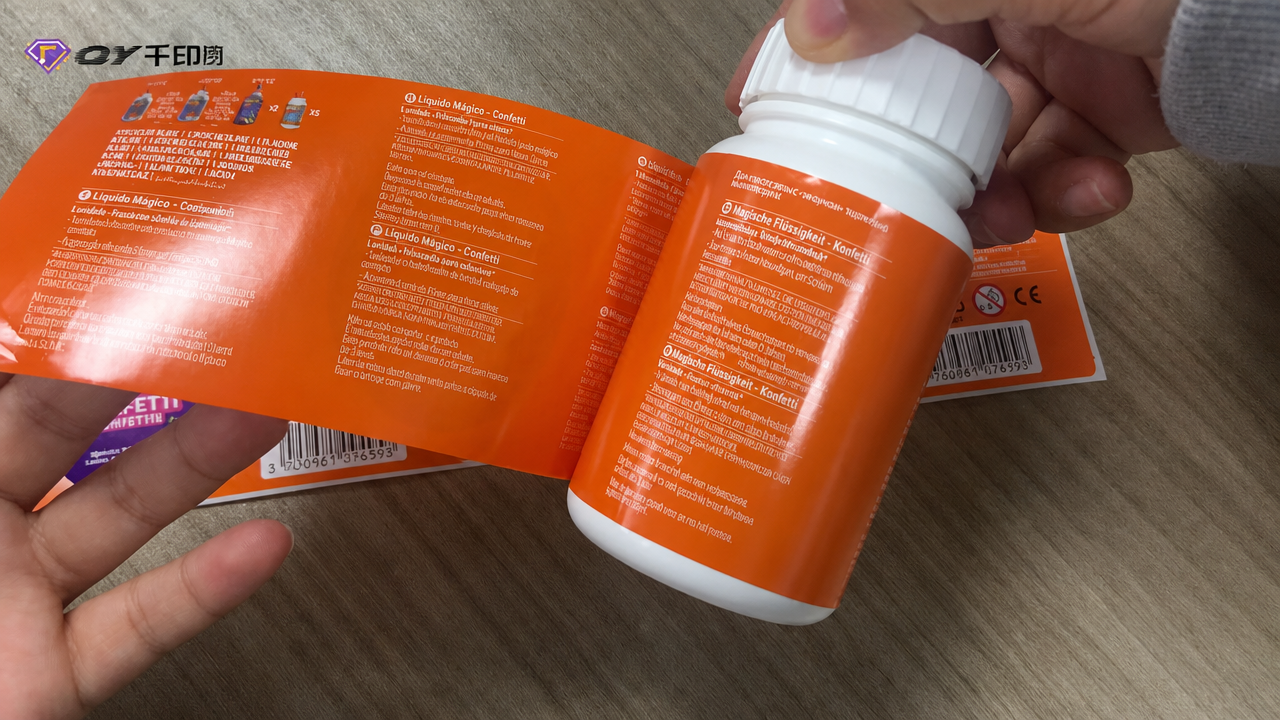
Paper, film, synthetic paper, adhesive, coating, and laminate can behave differently on glass, plastic, metal, coated paperboard, textured packaging, or flexible packaging. A general material name should not be treated as a performance guarantee. The final choice should be confirmed for the specific package and, where needed, checked through sampling.
For projects with variable data, the data position should be included in the structure and artwork review. Variable data labels may be relevant when each label needs a different code, serial, date, or other approved field, but the data format and proofing process still need to be confirmed before production.
Roll, sheet, and manual application are not interchangeable
A multi-layer label designed for sheets may not transfer directly to a roll format. The delivery format can affect spacing, orientation, fold position, thickness, unwind direction, and the way the label separates during application.
Sheet format
Sheets may suit manual application, sampling, or packaging operations that do not use a roll-fed applicator. The supplier still needs to know how the label will be removed from the sheet and positioned on the package.
Roll format
Roll supply may be considered for an application line, but the project should define unwind direction, leading edge, spacing, core, roll diameter, and the position of the opening or fold. The finished construction should not interfere with feeding or separation.
Manual application
Manual application may allow more flexibility in orientation, but the opening edge and adhesive zone still need to be clear. If the label is opened repeatedly after application, test it on a representative package instead of approving only a flat sample.
Automated application
Automated application requires more precise coordination between the label construction and the equipment. A late change from sheets to rolls, or from hand application to equipment, may require new spacing, imposition, or fold orientation. Tell the supplier the intended application method at the start, even if the final format is still under review.
Sampling and approval checklist
Before production approval, check the following items.
Structure
- Closed size and fully opened size are both stated;
- Layer, ply, page, and panel counts are clear;
- Front, back, inside, and outside surfaces are identified;
- Fold, hinge, cut, and opening lines are shown;
- Adhesive and non-adhesive zones are marked;
- The opening edge and reading direction are clear.
Package fit
- The label is shown on the intended package or a representative package;
- Curves, tapers, seams, recesses, and nearby components are considered;
- The closed construction fits the available label area;
- The label opens in the intended direction after application.
Artwork and print
- Every printable surface has the correct orientation;
- Text, barcodes, and QR codes do not cross functional boundaries;
- Foil, UV, embossing, and colour requirements are separated by surface;
- Bleed and safe areas are visible on the working proof;
- Variable data fields have an approved position and format.
Application and sample approval
- The sample uses the intended structure or is clearly labelled as a structural mock-up;
- The label has been checked closed, opened, and resealed if required;
- Manual or automated application has been tested where relevant;
- Final copy, languages, codes, and product information are approved by the brand owner;
- Material and application limitations are recorded before the production order.
FAQ: multi-layer label purchasing questions
Are multi-layer labels the same as booklet labels?
No. Multi-layer labels is a broad term. A booklet label is one specific construction that uses a booklet or leaflet attached to an adhesive base. Confirm the actual opening action, page count, and layer arrangement before quoting.
Can a multi-layer label carry multiple languages?
It can provide additional printable surfaces for multilingual content, but the final content, layout, and destination-market requirements must be confirmed by the brand owner. The format does not by itself approve or replace regulated information.
Can multi-layer labels be supplied on rolls?
Some structures can be prepared for roll delivery, but the unwind direction, spacing, thickness, opening position, and application equipment must be reviewed. A sheet design should not be assumed to transfer to rolls without checking.
Do I need a dieline for a multi-layer label quote?
A marked structural drawing or dieline is strongly recommended. It should show the closed and opened sizes, layer order, panel numbers, fold or hinge lines, adhesive zones, opening edge, and application orientation.
Should I request a physical sample?
A sample is especially useful when the label opens, reseals, wraps around a curved package, includes fine finishing, carries variable data, or must run through application equipment. Test it on the real or representative package where possible.
How to request a multi-layer label review
Send the package photo or drawing, closed and opened dimensions, layer or panel count, artwork or content list, material preference, adhesive requirement, application method, quantity, delivery format, destination market, and any barcode, QR code, variable data, or multilingual content.
If some information is not final, mark it as pending. A clear preliminary brief is more useful than a complete-looking file built on assumptions.
Review the Extended Content & Booklet Labels product page for related formats, then request a custom label quote with the structural information available. OnePrintPack can review the production conditions, artwork structure, material options, and sampling needs for the specific project. Final product content, approved files, and market compliance remain the buyer’s responsibility.
Source and risk notes
- This article uses the term “multi-layer labels” as a broad purchasing category. The exact structure must be confirmed by drawing, sample, and application details.
- The article does not promise a specific material, adhesive performance, delivery format, MOQ, production time, certification, or regulatory result.
- Variable data, finishing, roll delivery, and automated application are project-specific and require confirmation before quotation or production.
- The supplier can review production conditions and artwork requirements; the brand owner remains responsible for final product content, approved artwork, and market-specific compliance.